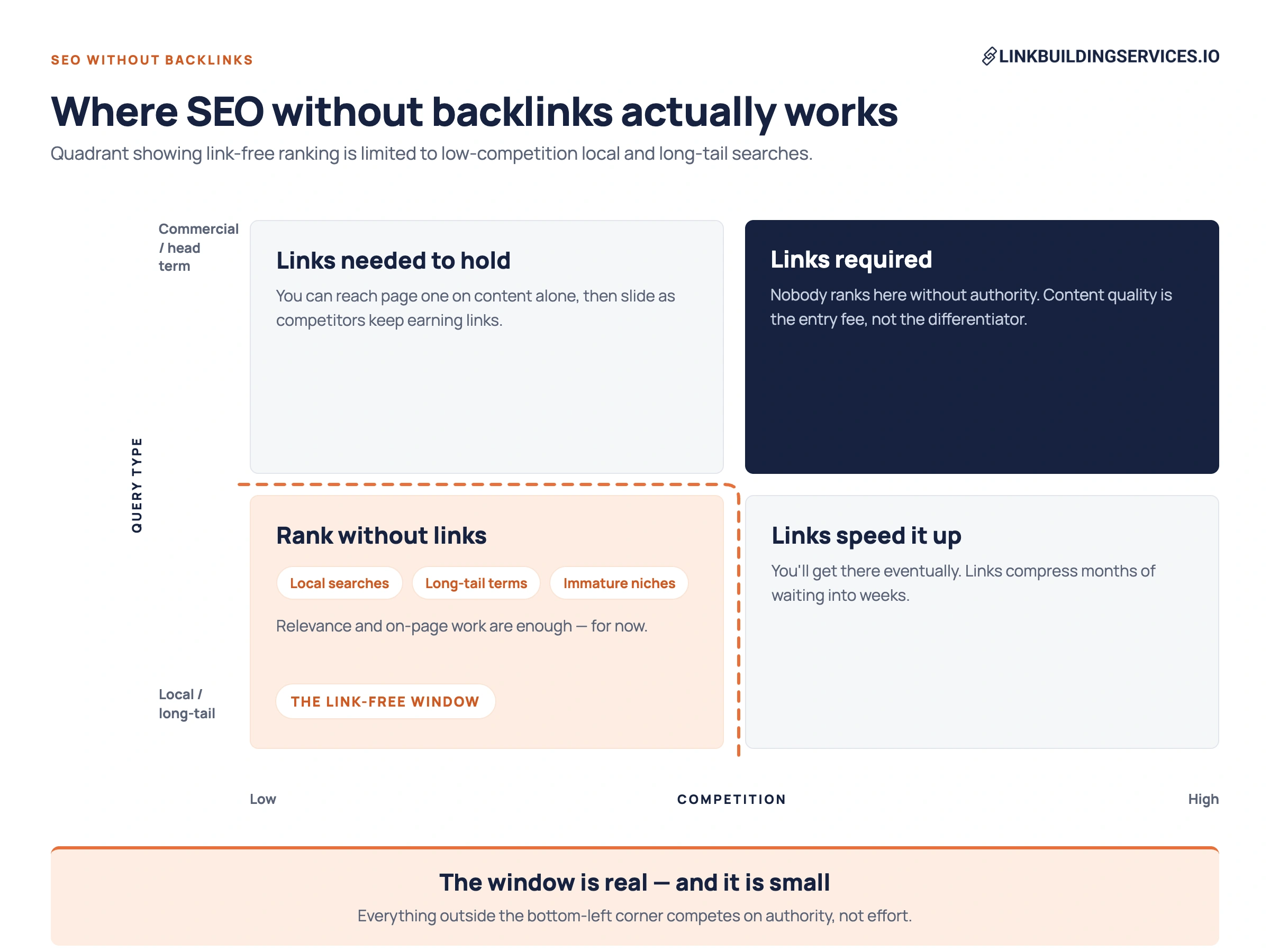
You can rank without backlinks in two places: local searches and low-competition long-tail keywords. Everywhere else, in mid-to-high competition and most established industries, backlinks are what will get you to page one and what will keep you there.
Here’s the distinction that matters. Content, on-page, and internal linking will make a page eligible to rank. Links will help decide how fast it gets there and whether it will hold the position once a competitor with a budget targets the same term.
And on a weak SERP, eligibility is enough having SEO without backlinks.
 This guide covers where that window actually sits, which link-free tactics work inside it and where each one stops, why the window closes on competitive SERPs, and the five-minute test that tells you which situation your page is in before you commit a quarter of work to it.
In This Article
- Where You Can Rank Without Links
- The Tactics Everyone Recommends, and How Far Each One Gets You
- Mid-to-High Competition: Why Links Stop Being Optional
- When the Authority Is Pointing at the Wrong Pages
- Local: Yes, But Make the Links Local
- How to Tell Which Side of the Line You’re On
- What Each Path Looks Like Over 12 Months
- Ranking Without Links in AI Search
- When to Start Building
Where You Can Rank Without Links?
There are 4 situations where your page can have with little to no link support (SEO without backlinks)- 3 of them actually are real opportunities.
Local Searches
This is the widest opening, as local rankings can run on a different signal mix than national organic. Proximity is essential to the search; Google Business Profile completeness, primary category selection, review volume and velocity, and consistent name-address-phone data (NAP data) across the web carry most of the weight in the map pack. None of these require links at the start.
The organic results below the map pack are more contested, but the same logic can be applied further down the tail. For instance, “emergency plumber” in a metro is a fight; “emergency plumber [suburb]” or “burst pipe repair [suburb] weekend” often isn’t – given that those pages can rank on having the page at all, written properly, with the exact location in the title and service described clearly.
Low-Competition Long-Tail Terms
Four or more words, low monthly volume, specific intent – examples would be “how to fix [specific error] in [specific software version]”, “Can you [specific action] with [specific product]” – the searchers here know exactly what they want.
So the economics here work differently from actual head terms. You don’t actually win by making one page strong – you win by covering 40 of them and adding up the traffic, and you can do that on content quality and internal linking alone given that the pages you’re contesting against are typically sections of broader articles, rather than dedicated answers.
The signal you look for is in the SERPs themselves – so if the top 10 contain Quora threads, Reddit posts, Medium articles, and forum answers, presumably nobody has built a real page for that query. So that’s a page-one position available to whoever writes the thing properly.
Under-served and Immature Niches
New products, new regulations, new tooling, new job titles – the SERPs for these spaces haven’t matured yet given that the topic is too recent for anyone to have invested in it.
The windows for these niches are genuinely lucrative and genuinely temporary. For instance, a term that’s wide open today can be fully contested in 18 months once the category grows and the vendors start funding content. So if you’re going to use this, you have to use it fast and use it deliberately – get pages up while the SERP is soft, and truly understand that holding those positions later is actually a different project than winning them now.
One That Isn’t What It Looks Like
Here’s where a lot of those “proof that backlinks don’t matter” theories come from.
You simply open a SERP and find one page at position 5 with 4 referring domains pointing at it – looks like a page ranking on almost nothing. Then you check the domain, and it’s DR91.
It’s ranking solely on the links its domain has already accumulated – thousands of them, built over years – pointing at the homepage and everything else.
So having that sitewide authority will lower the page-level link count every new page on that domain needs. What you’re actually looking at is a company that spends its existing balance. You have to check for two reasons:
First, if you’re on a new or low-authority domain, you can’t simply reproduce the results by copying their page. Second, and more importantly, it tells you something about where the SERP is soft. So having a position 5 page held by a strong domain with a thin page-level profile is often beatable by pointing a modest number of genuinely good links at a better page, and how to get backlinks from high authority sites covers the routes that reach that standard.
The Tactics Everyone Recommends, and How Far Each One Gets You
Every guide on this topic recommends roughly the same seven things. They all work, and none of them is wrong. What most articles leave out is the second column.
| Tactic | What it actually does | Where it runs out |
|---|---|---|
| Keyword selection | The highest-leverage decision you make, and it happens before you write a word | The moment a term has commercial value, somebody is funding it |
| Intent and format match | Buys eligibility; a mismatch loses regardless of quality | Parity, not advantage – everyone already ranking has done it |
| Topical clusters | Real authority signal that compounds across a section | Weak against a competitor with coverage and links |
| Internal linking | Routes existing equity to the pages that need it | Redistributes authority; never adds any |
| On-page and technical | Table stakes that prevent avoidable losses | Nobody outranks anybody on hygiene alone |
| Content updating | Defends positions you already hold | Defensive by nature, rarely a growth lever |
| Distribution | Puts content in front of the audience without waiting for Google | Works partly because it earns links incidentally |
Two of those rows deserve more than a line.
Internal linking doesn’t create authority, it moves it. If your site has authority somewhere – an old post that earned links naturally, a homepage carrying whatever the domain accumulated over the years – internal linking is how you route it to the pages that need it. Identify your two or three strongest pages, link from them to the pages you’re trying to move, keep important pages within three clicks of the homepage, and vary anchor text so it describes the destination. On a brand-new domain with nothing coming in, though, internal linking is dividing zero.
Distribution is link building with a longer lag. Reddit, YouTube, newsletters, niche communities, and industry forums genuinely move rankings, and it’s the tactic most worth adding if you’re doing none of it. But be clear about the mechanism: a meaningful part of why it works is that it puts your page in front of people who run websites, and some percentage of them link to it. That’s the same engine behind creative link building, just without the targeting.
What all seven have in common is that they make a page eligible. None of them closes the distance between you and a page holding 40 referring domains, because that distance is measured in domains and none of these tactics produces one.
Mid-to-High Competition: Why Links Stop Being Optional?
On highly contested SERPs, deserving to rank and ranking are different outcomes, and the gap between them has a specific shape.
Links Govern Speed and Durability, Not Just Position
First, with speed. Two identical pages that target the same term – one with links and one without – may both eventually reach page 1 on a moderately competitive SERP. One would take 3 months, and the other takes 11 – the difference here isn’t academic when you’re funding content that would fill those months.
Second is durability – just reaching position 4 may be a moment, but holding it through the next year, while competitors update their pages and point links at them, is a continuous state. So a page with no external support holds its position only as long as nobody with a budget will decide that they want it. That’s the ordinary state of play in b2b link building and in saas backlinks, where every page-one competitor is already funded.
The Plateau
The most common pattern in link-free SEO looks like success right up until it doesn’t.
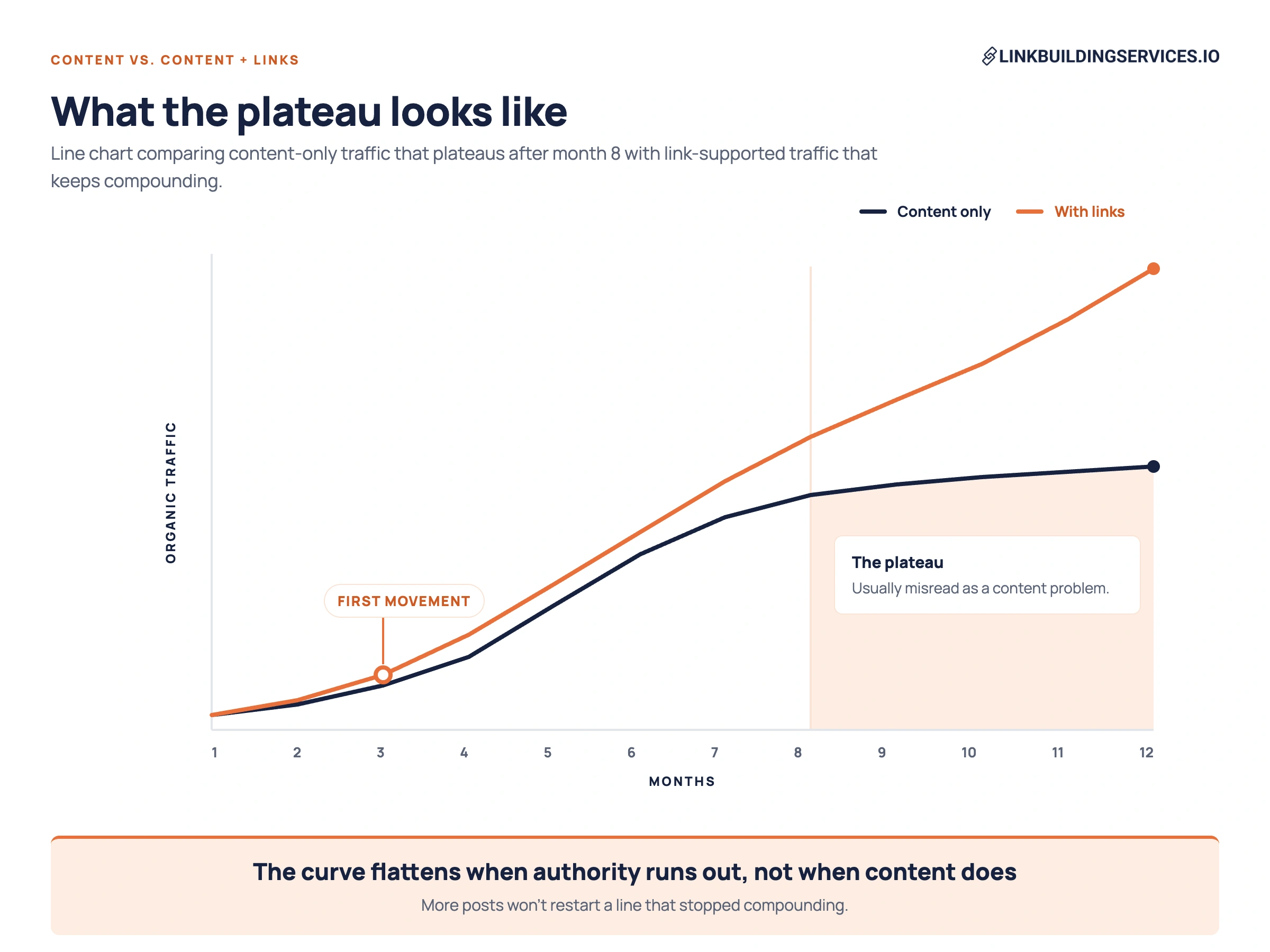 Months 1 to 4: indexing, long-tail impressions, a handful of positions in the twenties and thirties. Months 4 to 8: real growth – pages break into the top 20, a few reach page one on the softest terms, and traffic compounds month over month. The strategy looks validated.
Then it flattens. Not a drop, a ceiling. New posts perform like the last ones, existing pages stop climbing, and total traffic grows only by the amount each new page adds rather than by existing pages improving. The curve goes from compounding to linear.
This is the moment almost everyone misdiagnoses. The obvious read is that the content isn’t good enough, so the response is more content, longer content, better content – which produces more pages at the same ceiling. The actual constraint is that every remaining target sits on a SERP where the ranking pages have link profiles, and no amount of writing produces a referring domain.
Three Failure Modes
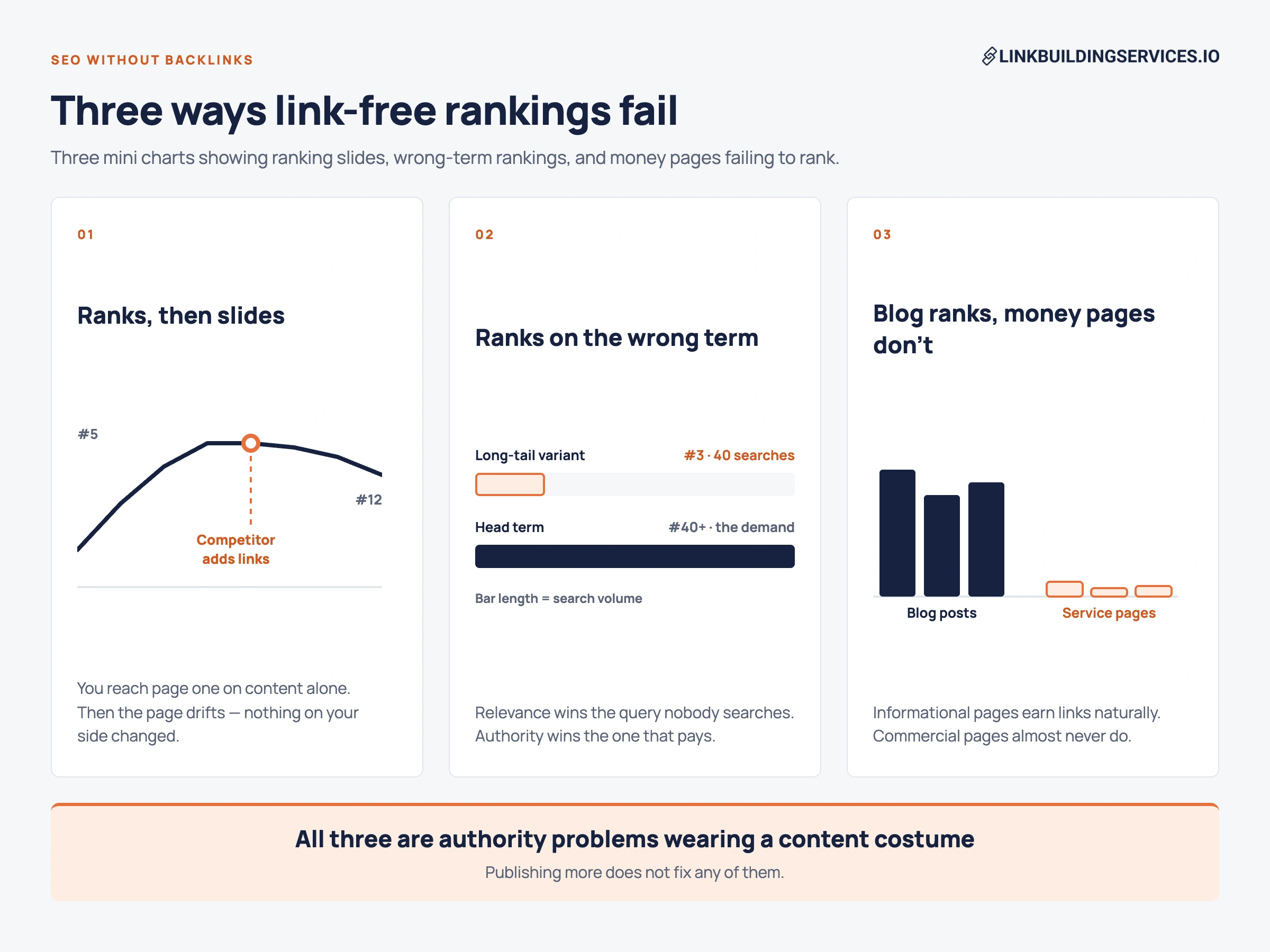 The plateau is an aggregate pattern – at the page level, it will show up in 3 specific ways:
- Ranks, then slides – a page that reaches position 5 or 6, holds for a few months, then will drift to 9th, then to 12th. Nothing happened to the page, then a competitor updated and pointed links at their version – so the page didn’t lose quality at all; it lost a contest it wasn’t equipped to compete against.
- Ranks on the wrong terms – the page picks up position 3 for a long-tail variant with 40 searches a month and just never surfaces for the head term it was written for. The traffic report might show movement, but the revenue doesn’t.
- Blog posts rank; money pages don’t – one of the most common of the three. Editorial content performs, sometimes very well, but service pages, category pages, and product pages still have no visibility – informational pages get linked to in a way commercial pages never do, and pages that convert are precisely the ones with no natural link acquisition. Anyone who has worked out how to build backlinks for ecommerce has run into this one first.
Maintenance is the part nobody quotes.
Every article on this topic is written about arriving, and almost none is written about staying. If you’re reading a “ranked without backlinks” case study, the only question that matters is what that page is doing now. A screenshot from 2024 proves the page got there. It doesn’t prove it stayed.
When the Authority Is Pointing at the Wrong Pages
One pattern is worth describing in detail, because it shows up constantly in established companies and gets treated as an editorial failure when it isn’t one.
A company holds a strong domain – say DR 70 plus, with thousands of referring domains accumulated over a decade. Then you look at where the organic traffic lands, and roughly 80% of it is on the homepage, driven by the brand name. Every non-branded keyword the site ranks for is a blog post. Not one is a product or solution page. And when you check the pages that describe what the company actually sells, they hold a dozen referring domains between all of them.
A competitor in the same category with fewer total referring domains pulls 4 or 5 times the organic traffic.
Nothing about that is a content problem. The pages exist and they’re fine, and the domain is strong enough. What’s wrong is allocation – a decade of accumulated authority pointing at a homepage and a blog, with nothing pointing at the pages that generate revenue. Writing more content doesn’t fix it. Checking your split of homepage backlinks against your page-level counts is how you confirm it, and it usually takes smaller numbers than anyone expects to correct, because the domain underneath is already doing most of the work.
Local: Yes, But Make the Links Local
Local is the strongest case for ranking without backlinks, and the section above said so without hedging. This is the asterisk – not a walk-back, but the part that decides whether local SEO takes you 2 months or 9, and whether you own your suburb or the whole metro.
Proximity Covers Your Suburb, Not Your Metro
Proximity is doing enormous work in local results, and proximity is not something you can build. Searchers near your address see you; searchers across the city see whoever is near them. For a business whose customers are all within a few kilometres – a cafe, a dentist serving one neighbourhood – that’s often enough.
For a business that serves a whole metro, it isn’t. Plumbers, HVAC contractors, roofers, movers, law firms, anyone dispatching across a region: your customers are searching from 40 suburbs, and proximity only favours you in one of them. Ranking in the other 39 means outweighing somebody else’s proximity advantage, and authority is the only lever that does that.
This is the ceiling most local businesses hit and misread. Rankings look excellent – from the office. Run the same search from a suburb 20 kilometres away and the business is nowhere. That isn’t a GBP problem or a content problem. It’s an authority problem with a geographic shape.
Competitive Local Verticals Behave Like National SERPs
The “local is easy” advice assumes a soft SERP, and some local SERPs aren’t soft at all. Legal, dental, cosmetic and medical practices, HVAC, roofing, personal injury, and water damage restoration all have competitors in tier-one metros who have been building links for years, because the customer value justifies it. A single case or a full roof replacement funds a lot of link acquisition.
That’s why link building for lawyers and link building for dentists look nothing like the plumber-in-a-suburb example – those SERPs behave like national commercial SERPs that happen to have a map pack on top. Check before assuming: open the term, look at the organic results under the pack, and count referring domains on the ranking pages. If positions 1 to 3 hold 40 referring domains each, the local exception does not apply to you.
Localized Links Are a Speed Multiplier
For businesses genuinely inside the local window, links aren’t required – they’re what compresses the timeline. Same page, same GBP, same content: a business building a handful of geographically and topically relevant links typically reaches competitive local positions in a fraction of the time it takes on content alone. In most metros that’s the difference between a 2 to 4 month climb and a 6 to 9 month one, and you’re earning revenue during the months you’d otherwise spend waiting.
Citations are not local links.
Citations are directory listings carrying your name, address and phone number. They matter for consistency and verification, they’re largely commoditised, and every competitor has the same ones.
Local links are editorial links from sites with real regional or topical relevance: regional news outlets, chambers of commerce, suppliers and partners with dealer pages, sponsorships of clubs and community events, city guides with actual readership. The qualifying test is whether the linking site has an audience in your market – which is why a plumbing company in Dallas gets nothing from a blog in Auckland, whatever its Domain Rating says. The best backlinks for local seo pass on relevance in both dimensions that matter: topic and place.
How to Tell Which Side of the Line You’re On?
Everything above is a description of two different situations. This is how you find out which one your page is in, and it takes about five minutes per keyword.
Run the Gap Test
- Open the live SERP for your target term.
- For every ranking page, record page type, DR, URL Rating, and referring domains to that URL – not to the domain.
- Take the median of positions 1 to 3.
- Find the lowest referring-domain count holding a page-one position. That’s your entry checkpoint.
- Subtract what your page holds today. That number is your gap.
Use the median rather than the average. One aged industry listicle sitting on 84 referring domains will skew the target to a number nothing on that SERP actually needed, and you’ll end up quoting yourself a budget for a position nobody had to buy. Counting page-level referring domains rather than raw backlinks is also the whole point of measuring link popularity instead of link volume, and how many backlinks do i need works the same arithmetic through a full page set.
Reading the Number
| Your gap | What it means |
|---|---|
| 0 to 2 domains | The tactics in this article are genuinely enough. Go and write. |
| 3 to 9 domains | Reachable, but only with concentration – several links on one page, not one link each on several. |
| 10 to 22 domains | Months of sustained work. Content alone stalls here, every time. |
| 90+ domains | Held by exact-match domains or institutions. Pick a different term. |
Two things this test also tells you. If your page already holds more referring domains than the pages outranking it, links aren’t your problem at all – it’s intent mismatch, thin content, or internal linking, and that’s roughly one page in six. And if a term needs 31 domains to reach the top three while carrying 210 searches a month, the arithmetic disqualifies it no matter what your budget is.
Once you know the number, the prospect list mostly writes itself: steal your competitors backlinks covers pulling the domains already linking to the pages above you, which is where the closest matches usually are.
What Each Path Looks Like Over 12 Months
Content only. Months 1 to 3 are indexing and long-tail impressions. Months 3 to 6 bring the first page-one wins on the softest terms. Months 6 to 12 are where the plateau appears, and where most sites respond by publishing more into the same ceiling.
With links. First movement typically shows around month 3, with a fair read on the investment at month 6. Link acquisition compounds; it does not spike, and how long for backlinks to take effect sets out what movement looks like month by month.
Local, either way. The same shape on a shorter clock – suburb-level terms can land inside a quarter on content alone, while metro-wide visibility follows the linked timeline rather than the unlinked one.
Ranking Without Links in AI Search
Being cited in AI Overviews and LLM answers runs on a different mechanism than blue-link ranking, and it’s the part of this question the existing guides skip entirely.
What matters there is entity understanding rather than link count: the topical and semantic relevance of the linking page over its raw DR, whether the placement is crawlable and indexed, and how often your brand appears alongside the other trusted names in your category. That last one is why co citation link building and brand mentions for seo matter more in AI results than they ever did in classic organic – an unlinked mention next to the right entities still moves the association.
So AI search doesn’t remove the need for links. It changes which ones count. A contextually relevant placement on a mid-DR site in your category outperforms a DR 80 link from a generic blog, which is the case for niche relevant backlinks stated in a different vocabulary.
When to Start Building
Three triggers, any one of which is enough:
- Your traffic curve went linear somewhere between month 6 and month 12.
- The gap test returns more than 3 on a term you actually need.
- You’re moving from blog content to money pages.
When you do start, concentration beats coverage by a wide margin. Six links on one page moves that page; one link each on six pages moves nothing. A young site should weight heavily toward content links while the profile is still forming – link building for startups covers the first 90 days – and the practical ceiling on monthly volume is set by reply rate rather than budget, which link building outreach works through in detail.
On format, guest posting vs niche edits covers which suits which target, and how much do backlinks cost gives you a per-link figure to multiply your gap against. Whatever you build, keep it inside link building best practices – a gap closed with links that get discounted is a gap that isn’t closed.
Done for you
Want the gap run on your own pages first?
Send us the pages you’d prioritise. We run the same analysis against whoever is outranking them and show you the number before you spend anything:
- A referring-domain target per page – not a package guess
- A quick-win shortlist – the weak-profile competitors you can outrank first
- Pages we’d tell you to skip – when links aren’t the answer, we say so
- You approve every domain – before a single email goes out
Bottom Line
You can rank without backlinks, and in local and long-tail you often should – building links for a term nobody is contesting is money spent on a race you’d win anyway. But the honest version of the answer has a boundary in it, and the boundary is measurable rather than philosophical.
Count the referring domains on the pages above you. If the number is small, write. If it isn’t, no amount of content changes the arithmetic, and the months you spend proving that are the expensive part. If you want the wider case for what links do beyond a single ranking, benefits of link building covers it, and our shortlist of the best link building services is a starting point if you’d rather not run it in-house.
Written By

Reviewed By

Sef Gojo Cruz
COO at SharpRocket, overseeing end-to-end operations, from crafting link building strategies to leading high-performing teams. Previously led SEO initiatives at Workhouse, a digital agency in Australia, and Keymedia, a real estate media company based in New Zealand.