Tiered link building is a strategy that simply arranges backlinks in layers. So think of having Tier 1 links point at the page being ranked, Tier 2 links point at those Tier 1 pages, and Tier 3 links point at Tier 2 – each layer is meant to strengthen the one that’s above it.
The problem is that nobody agrees on whether you should actually do it. Ahrefs files it under black hat in its own glossary. Page One Power describes it the same way. Most of the agencies ranking alongside them call it gray hat, safe in competitive niches, and – usually a few scrolls later – available as a monthly retainer.
This guide resolves that. You’ll get a straight answer on whether tiering is against Google’s guidelines, what the December 2022 link spam update did to the pyramid, what a tiered package costs against what the same budget buys at Tier 1, and the three-part allocation we use instead.
In This Article
- Does Tiered Link Building Still Work?
- How Tiered Link Building Works
- Two Different Claims, Often Blurred Together
- Is Tiered Link Building Black Hat?
- After the Link Spam Updates
- Skip the Tiers: Point Links Where They Land
- So Which Has More Effect?
- How to Split Your Link Budget
- What Tiers Cost vs. the Same Spend on Tier 1
- How to Vet a Tiered Link Vendor
- Better Ways to Get the Same Outcome
- Tiered Link Building FAQs
Does Tiered Link Building Still Work?
Simple answer:
No, not for most websites. The budget belongs at Tier 1, pointed directly at your own pages. Since the December 2022 link spam update, Google’s stated approach to manipulative links is to neutralise them rather than penalise the site – and a layer that passes nothing strengthens nothing above it.
Defensible in one narrow case: manually built Tier 2 links aimed at valuable Tier 1 placements that aren’t getting indexed, on a site where Tier 1 acquisition has genuinely plateaued. Not defensible: automated Tier 2 or Tier 3 pointed at anything you can’t afford to lose.
How Tiered Link Building Works
Every version of this link building tactic just rests on one idea: a backlink is itself a page, and pages can be strengthened. For instance, if a guest post linking to your service page ranks better, gets indexed faster, or accumulates its own authority, the argument goes, and the backlink it gives you is actually worth more. So you simply build links to your links.
In practice that means having three layers:
Tier 1 links point directly at the page you certainly want to rank: service page, product category, or blog content. These are links that do the actual work, and the ones you’d build anyway even if you don’t hear about tiered link building at all. In most campaigns they arrive as guest posts or link insertions, and guest posting vs niche edits covers which format suits which target.
Tier 2 links point at those Tier 1 pages. Not at your site at all. So if your Tier 1 link lives in a guest post on a relevant website, Tier 2 links point at that guest post – as simple as that.
Tier 3 links point at Tier 2. So by this layer, there are 3 intermediate pages between the link and your site – and quality has usually stopped being the consideration here; volume matters more for most SEOs who are executing this. It’s the layer where easy backlinks get bought in bulk, precisely because nobody expects them to be read.
To put it simply, the structure is almost always drawn like a pyramid: few strong links at the top, more and cheaper ones at each descending layer. And that image is actually doing some persuasive work, given that it implies a foundation holding something up. A more accurate picture is a chain, where every link in it can break independently.
Two Different Claims, Often Blurred Together
It’s actually worth separating these before going any further, given that they’re usually presented just as one argument.
The equity claim is that authority will flow upward through layers, so a Tier 2 link will strengthen the Tier 1 page, which will pass more value to your site. This is the claim that sells packages, and it’s the one that has aged worst.
The indexation claim is narrower, and it’s more mechanical: if Google never crawls a backlink, it can’t count for anything, so simply pointing a link at that page can help get it discovered. So no authority transfer required here – this claim is actually more plausible. If a chunk of your placements have gone missing entirely, backlinks not showing up in ahrefs explains what’s usually behind it.
| Layer | Points at | Typical sources | Typical cost | Realistic impact |
|---|---|---|---|---|
| Tier 1 | Your money page | Guest posts, niche edits, digital PR, resource pages | $150 to $600 per link | Real and measurable |
| Tier 2 | Tier 1 pages | Web 2.0s, Medium posts, link insertions, secondary guest posts | $20 to $100 per link | Marginal; possible indexation help |
| Tier 3 | Tier 2 pages | Profiles, forum posts, blog comments, bookmarks, directories | Pennies, sold in bulk | Effectively zero |
Read down the right-hand columns and the problem is visible without any further argument: cost falls faster than value does, but value falls all the way to zero. You’re buying volume in the layers where volume doesn’t matter, which is the same mistake as counting raw backlinks instead of link popularity.
Is Tiered Link Building Black Hat?
This is the question the search results create and then refuse to answer. So here’s the direct version: the structure isn’t the problem – the method is.
Google’s spam policies don’t contain the phrase “tiered link building.” They don’t need to. The link spam policy covers any links intended to manipulate rankings, and it explicitly names the mechanisms tiering relies on: buying or selling links for ranking purposes, excessive link exchanges, low-quality directory and bookmark submissions, forum comments with optimised anchor text, and automatically generated links.
Read that list against the Tier 3 row above and it’s a near-perfect match. A page describing Tier 3 as “safe because it doesn’t touch your site” is arguing about blast radius, not about whether the policy applies. It applies.
Now the other side, honestly stated. Suppose you publish a guest post on a real industry publication and it links to your service page. Three months later it hasn’t been indexed. You write a genuine piece for another publication and reference that guest post in it, because it’s relevant. That’s structurally Tier 2, and nothing about it is spam.
So two things are true at once, which is why this question stays unsettled:
- Manually built, editorially justified links that happen to point at pages linking to you are not black hat. They’re just link building, and calling them Tier 2 makes them sound more systematic than they are.
- Tiered link building as a purchased service is black hat. It relies on automated lower tiers that Google’s spam policy names by mechanism, and no vendor is selling a pyramid built entirely by hand, because the economics don’t allow it.
The useful test isn’t “is tiering black hat.” It’s would this link exist if I weren’t trying to boost another link? If yes, you’re fine, and you don’t need the tiering vocabulary to justify it. If no, you’re inside the policy regardless of which layer it sits on. That test is the short version of our link building best practices.
Does Tiered Link Building Still Work After the Link Spam Updates?
Tiered link building mostly doesn’t work, and the reason is that there’s a change in how Google handles manipulative links that a lot of tiering content hasn’t caught up to.
Penalizing Became Neutralizing
For most of tiering’s history, the worst case actually was a penalty. So you built something manipulative, Google caught it, and your rankings simply dropped; you then disavowed and filed a reconsideration request. That framing is still how most tiered link building content discusses risk – it’s like a gamble where the downside is getting caught.
Google stated the approach shifted with the December 2022 link spam update, which is built on SpamBrain. So rather than simply acting against sites, the system was described as nullifying the links themselves: identifying spam backlinks and simply not counting them.
Sit with what that does to a pyramid. The entire mechanism of tiering is transmission. A Tier 2 page receiving a hundred neutralised links is in exactly the same position it was before those links existed. It isn’t stronger, so it has nothing extra to pass upward. The layer is inert.
This is why many take tiered link building as low risk, given that it doesn’t touch your site, and it pulls against each other harder than vendors will admit. The distance that makes the lower tiers safe is the same distance that makes them worthless. You can’t be far enough away to be harmless and close enough to matter.
The success stories don’t isolate the tiers.
Almost every case runs the same way: someone built Tier 1 links, then built tiers underneath them, then rankings improved. But the Tier 1 links were new, and new links take months to show effect. Content was usually being published at the same time. The tiering happened inside a period of general activity and got credit for the outcome.
Where That Leaves This Link Building Tactic
Tiered link building is a solution that’s built for an older version of the system. It made sense when links were counted more mechanically, when spam links would pass value before anyone caught them, and when the main risk was detection rather than just dismissal.
What’s left really is a tactic that costs real money, violates a stated policy, has no published evidence behind it, and whose one legitimate use case has a free substitute.
Now that leaves us with this remaining question: if that budget isn’t going into tiers, where does it go?
Skip the Link Building Tiers – Point Links Where They Actually Land
The budget answer here is simple enough that it’s almost anticlimactic: just build more Tier 1 links. Same money, same effort, but pointed one hop away instead of just three.
That isn’t a clever alternative really; it’s just the thing tiering was always a substitute for. Layers usually get built given that Tier 1 links are difficult to get and lower tiers are just easy to buy, so a pyramid lets a budget feel deployed without anyone having to do the difficult part.
Now, what matters most is: which page on your site should the link point to?
Direct to the Commercial Page
Target links pointing at the service page, product page, or category page – which has the most concentrated effect available on that page’s ability to rank, given there’s nothing in between. For instance, if a revenue page needs to move for a high-intent term, this is actually the most efficient way to move it, and how many backlinks do i need shows you how to work out how many that page actually requires.
They are rarely earned. The reality is almost nobody links to a commercial page voluntarily. So most direct commercial links are actually placed rather than just earned: paid, exchanged, or negotiated, which can put them in the category that Google’s link spam policy addresses most directly. That makes sourcing the whole game – niche relevant backlinks are the ones that survive a manual read.
Anchor text turns into a signal fast. Having, like, a commercial page with a backlink profile that’s dense with exact-match anchor text is one of the more legible manipulative patterns you can see. So with direct links, you need mostly branded anchors, with a measured combination of exact match and partial match.
They don’t scale. You may be able to build a handful of good landing page links, but not a hundred in a month for your profile. You have to use them deliberately and sparingly, only on pages that carry revenue, at a volume that’s plausible for a website your size. When you do need to clear a higher bar, how to get backlinks from high authority sites covers the routes that work.
Direct to the Content
Links to articles, guides, and original-data pages are the opposite trade in almost every respect. They can be genuinely earned, which can mean they’re acquired at volume, from better domains, with more natural anchor texts, and without anyone even being paid for link placements. Formats like skyscraper seo link building exist for exactly this job.
The only weakness here is that the value reaches your commercial pages indirectly through internal linking.
But look closely at what kind of hop that is. You own the linking page. You wrote the anchor text. You know it’s indexed, because you can check. Every uncertainty that made a Tier 2 hop unreliable is gone, because the intermediate page is yours.
Internal linking here does the job Tier 2 claims to do, and does it reliably. So if you’re building links to content, the link from that content to any relevant commercial page is a transmission step.
So Which Has More Effect?
For one page that’s ranking for one term, direct landing page links win. For a website’s overall capacity to rank, you need to have some content links, not only because each is much stronger, but given that you can get far more of them, from better domains, without accumulating too much risk.
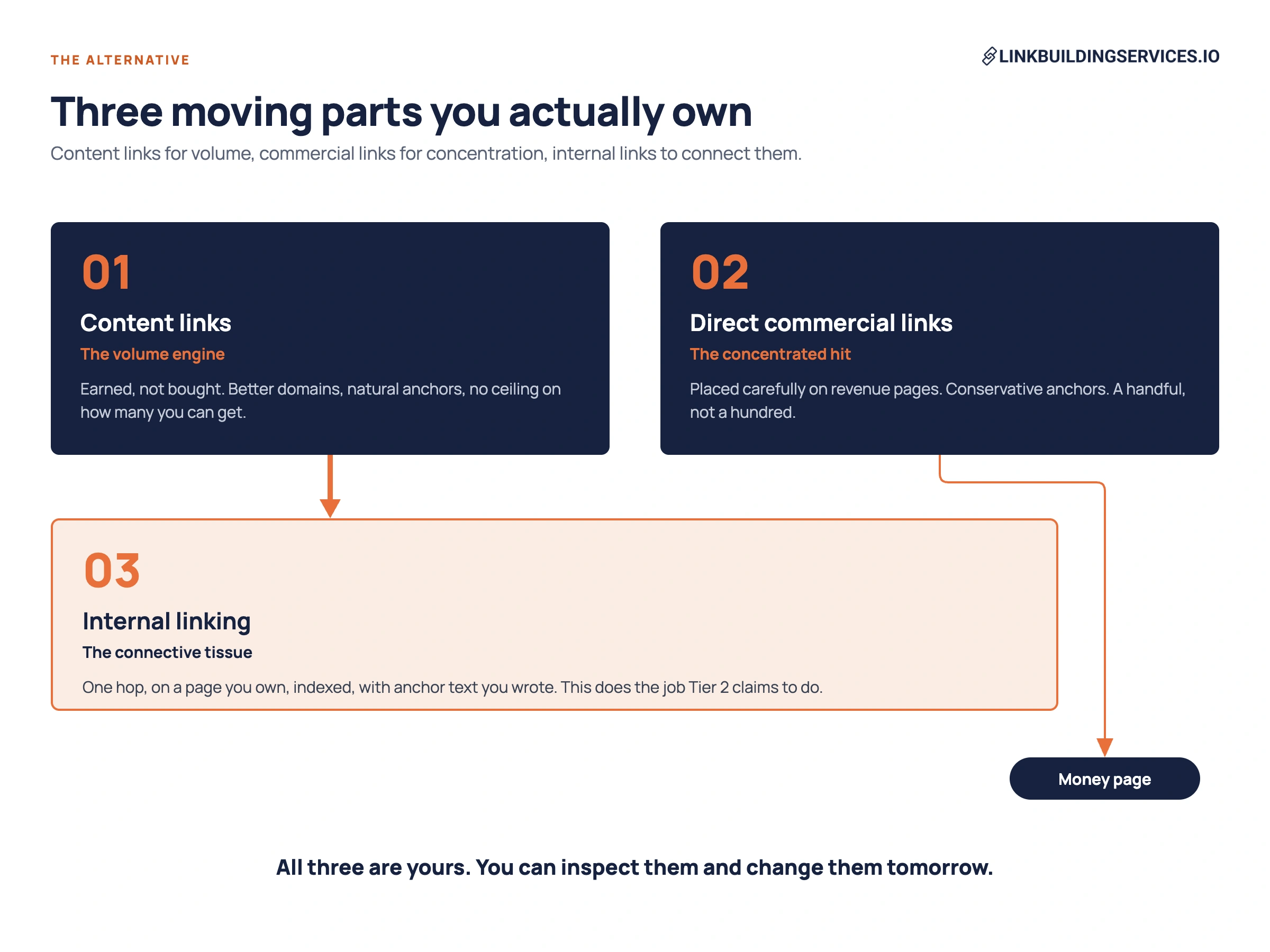 Allocation is the best route to this:
- Content links as the volume engine – bulk of your link acquisition, earned rather than purely bought, and all anchored naturally.
- Smaller number of direct commercial links – placed carefully, on revenue pages with conservative anchors.
- Deliberate internal linking – connecting first to second, and treating it as infrastructure.
These are 3 moving parts, all of which you own, can inspect, and can change tomorrow. You need to set that against a pyramid, where layers supposedly doing the work sit on properties you don’t actually own.
How to Split Your Link Budget?
Allocation first, then do diagnosis. The three-part model here: content links for volume, a small number of direct commercial links, then internal linking as your site’s connective tissue.
New or Low-Authority Site (under ~2 years, thin backlink profile)
Weight heavily toward content; you can call it 80% content links, 20% direct commercial, though you have to treat that as a starting posture. The basic reason is the link profile’s conservatism, given that a young domain whose earliest links point at service pages with commercial anchor text may look manufactured – because it is.
Content links let you actually accumulate domain authority while the link profile still reads naturally. And internal linking matters less here simply because there’s less to connect, but you build the habit early. If you’re starting from nothing, link building for startups covers the first ninety days in more detail.
Plateaued Website (rankings stalled despite ongoing effort)
It’s usually a diagnostic problem, so before changing any link allocation, you need to find out which of these 3 things is stuck: not enough authority overall, authority that isn’t reaching commercial pages, or pages that can’t rank for reasons links couldn’t fix, like intent mismatch, thin content, or the website’s technical SEO issue.
If it’s genuinely authority, you need to shift toward commercial: roughly 60/40 content to direct, and audit internal links to target pages before spending anything. Worth checking your split of homepage backlinks against page-level links here too, because a homepage-heavy profile is the most common version of “authority that isn’t reaching the money pages.”
Established Site (solid profile, competing on hard terms)
Closer to 50/50, with commercial links concentrated on a short list of pages that actually generate revenue. At this stage, the constraint really is rarely volume – it’s usually that link acquisition has become diffuse: link here, link there, spread across pages that nobody has really prioritised.
The key is to pick the pages that matter most and point things at them. What sets your realistic monthly ceiling isn’t risk tolerance but reply rate, and link building outreach covers what volume of prospecting a target of four to six live links a month actually requires.
What Tiers Cost vs. the Same Spend on Tier 1
This is the comparison nobody selling tiered packages puts on the page. Entry-level tiered packages tend to start around $3,000 to $8,000, with managed programmes running $15,000 to $30,000. Here’s what that same money does if you skip the pyramid.
| $6,000 budget | What you get | What reaches your site |
|---|---|---|
| Tiered package | Roughly 8 Tier 1 links, plus a few hundred Tier 2 and Tier 3 links underneath them | 8 direct links, plus layers Google has stated it aims to discount |
| Tier 1 only | Roughly 20 to 24 qualified links at $250 to $300, all pointed at your own pages | 20+ direct links, every one auditable |
The rate you plug into that comparison moves the answer more than anything else in it. How much do backlinks cost breaks the figure down by acquisition channel, and link building packages explains what a monthly retainer should include before you sign one. If you’re buying placements directly, best places to buy backlinks and link building marketplaces are where most of that Tier 1 budget ends up.
How to Vet a Tiered Link Vendor
If you’re going to hire someone anyway, the risk isn’t the concept, it’s what gets built under your name without your knowledge. Four things to demand before you sign:
- The full URL list for every tier. Not just Tier 1. A vendor who’ll show you the top layer and describe the rest is telling you the rest won’t survive inspection.
- Manual or automated, in writing. Ask directly whether GSA Search Engine Ranker, RankerX, or similar tools are used at any layer. Compare their stack against the best link building tools, which do prospecting and monitoring rather than mass posting.
- Confirmation that nothing automated touches your domain. Including redirects, parked domains, and any property they control that links to you.
- Reporting that shows what survived. Live URL, anchor, and DR per placement. Link building reporting sets out the standard, and why use a backlink monitor tool explains how to catch removals yourself.
Red flags are consistent: undisclosed Tier 2 and Tier 3 URLs, volume promises, and “indexation guaranteed.” If you’re weighing providers rather than tactics, outsource backlinks covers what to ask for, and our list of the best link building services is a starting point for comparison.
Better Ways to Get the Same Outcome
Every goal tiering claims to serve has a cheaper and safer route. Sorted by what you’re actually trying to fix:
- Getting Tier 1 links indexed. Internal link to the page that links to you, share the placement where it gets crawled, and ask the publisher to surface it. All free, all under your control.
- Recovering value you already earned. Link reclamation and brand mentions for seo turn existing coverage into live links, usually at a fraction of the cost of a new placement.
- Building volume without buying it. Creative link building, testimonial link building, and event link building all produce links that exist for a reason other than SEO, which is the test from earlier in this article.
- Finding targets that already link to your competitors. Steal your competitors backlinks and how to lookup guest post opps on ahrefs give you a prospect list without a pyramid.
- Association without a link at all. Co citation link building works on being mentioned alongside the right brands, which is closer to what tiering was reaching for than tiering ever got.
Done for you
Want that budget pointed at Tier 1 instead?
No pyramids, no layers you can’t inspect. Every link points at a page on your site, and you see all of them:
- Tier 1 only – nothing built on properties you don’t control
- Qualified domains only – real traffic, real relevance, scored before outreach
- You approve every domain – before a single email goes out
- Full visibility – every live link with its placing URL, anchor, and DR
Bottom Line
Tiered link building isn’t a shortcut past the hard part of link building. It’s a way to spend money that feels like link building while the actual constraint – earning links people would place anyway – goes untouched.
Put the budget into Tier 1. Run content links as the volume engine, a small number of direct commercial links on the pages that carry revenue, and internal linking that connects the two. Three moving parts, all of which you own and can inspect, which is more than any pyramid can offer.
And if you’re weighing whether links are still worth the spend at all, the benefits of link building makes the wider case beyond rankings alone.
Written By

Reviewed By

Sef Gojo Cruz
COO at SharpRocket, overseeing end-to-end operations, from crafting link building strategies to leading high-performing teams. Previously led SEO initiatives at Workhouse, a digital agency in Australia, and Keymedia, a real estate media company based in New Zealand.