Most guides on natural backlinks blur one important line. “Natural” quietly becomes just natural-looking, and the advice of most SEO professionals can turn into how to make a bought link pass as an earned one.
In this guide, you’ll get a straight definition of natural backlinks, a simple way to tell them apart from semi-natural and built links, what a natural backlink profile looks like, and how to earn more natural links.
In This Article
What are Natural Backlinks?
A natural backlink is a backlink someone voluntarily gives your page, given that they decided it was worthy of pointing their readers to. You didn’t pay for it, nor trade for it, or ask for it – it simply happened given your page was useful, interesting, or the best source on the topic.
The simplest way to judge a backlink is with three tests:
- Nobody paid – no money, free product, discount, or service changed hands.
- Nobody traded – it isn’t part of a “you link to me, I’ll link to you” kind of deal.
- Nobody asked – you didn’t pitch it, request it, or supply the text around it.
Now, if a backlink passes all three of these tests, you can call it “natural”. If it fails one, it isn’t necessarily bad at all, but it sits somewhere else on the spectrum.
Why Natural Backlinks Matter?
Natural backlinks are the clearest signal that other people find your page worth referencing. That’s why they carry so much weight.
They signal real trust.
When an editor chooses to link to you without being asked, it tells search engines your page earned its place. This is the core idea behind link popularity: it isn’t only how many sites link to you, but which ones and why.
They last.
Links that editors chose tend to stay in place for years. Nobody removes them when a contract ends or a budget runs out.
They send real visitors.
Someone linked because your page helps their readers, so the people who click through are usually interested in what you offer.
They keep coming.
A page that earns links on its own often keeps earning them, because every new citation makes it easier for the next writer to find.
These are a big part of the wider benefits of link building, and they’re why natural links are worth earning alongside any links you build.
Natural Link Spectrum: Natural, Semi-Natural, and Built Links
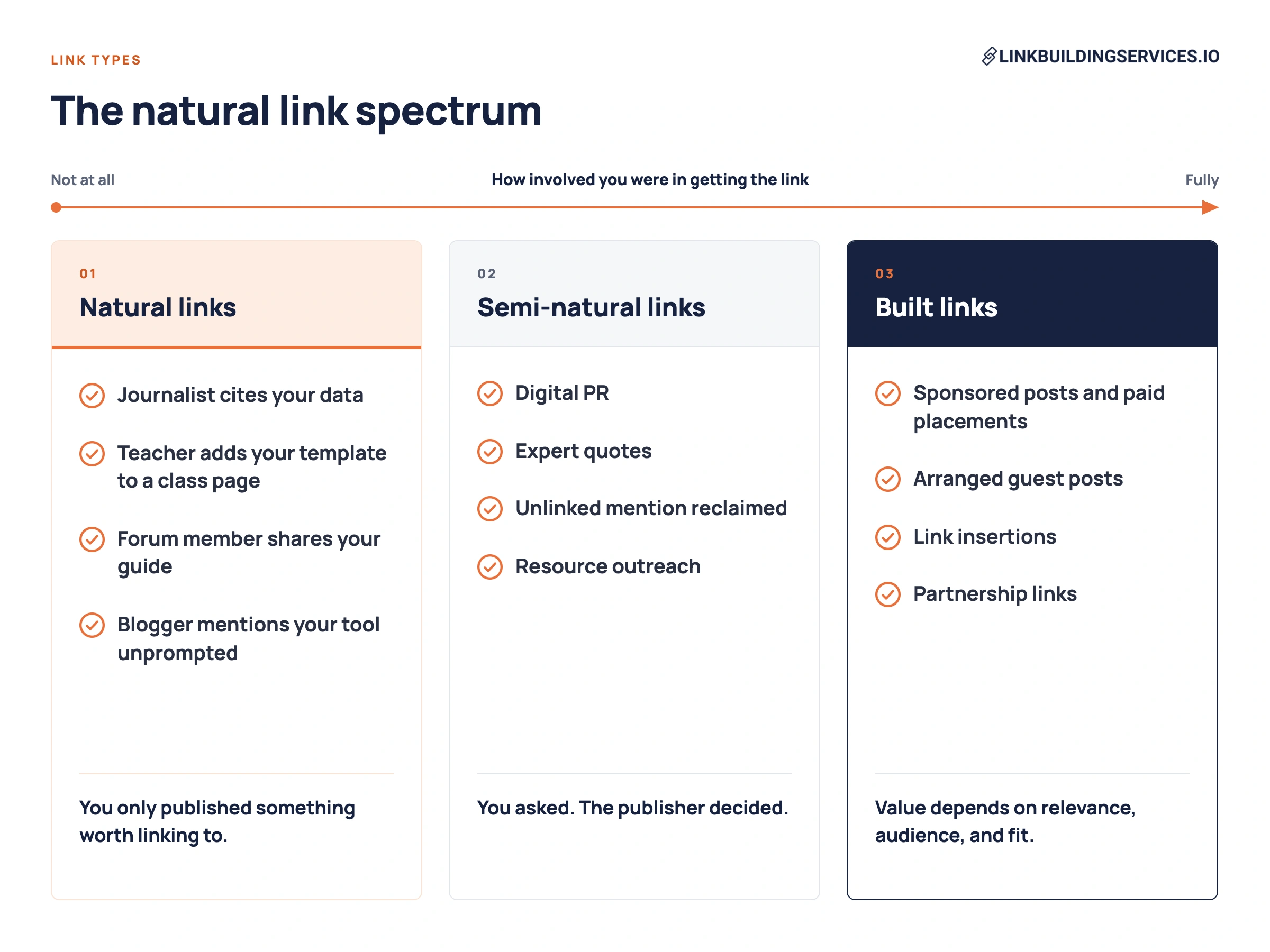
Most backlinks don’t fall neatly into just “good” or “bad.” It’s actually more useful to think of them on a spectrum, based on how much you were really involved in getting them.
 Natural Links
These are backlinks that just pass all three tests. For instance, someone has just found your page on their own and just linked to it given that it helped their readers.
Common examples of these are:
- A journalist cites your survey data in a news story.
- A teacher simply adds your free template to a class resource page.
- A forum member shares your guide to answer someone’s question in the community.
- A blogger mentions your tool in one of the roundups they wrote without contacting you.
With natural links, you basically had no part in these beyond just publishing something worth linking to.
Semi-Natural Links
These are backlinks that you worked for, but the other site still made its own editorial decision. You actually showed them something useful, and they chose whether to link.
Common examples of semi-natural links are:
- Digital PR – you pitch a story or dataset to journalists, and some of them would cover it. For campaign ideas that tend to get picked up, see creative link building.
- Expert quotes – you answer a journalist’s request, and they genuinely quote you with a backlink.
- Unlinked mentions – a website already mentioned your brand, and you politely ask them to add your link. This is a core part of link reclamation.
- Resource outreach – you nudge a site owner about a genuinely useful page that fits well with their content. Our guide to link building outreach covers how to do this well.
Built Links
These are backlinks you actively manage, often through paid placements, sponsored posts, or partnerships with publishers. They’re a typical part of how many brands grow visibility, the exact same way companies would pay for advertorials, sponsorships, or placements in print media.
Common examples of built links include:
- Sponsored posts and paid placements on relevant publications (see the best places to buy backlinks)
- Guest posts that are arranged with a site’s editor
- Link insertions in existing, relevant articles (if you’re weighing the two, see guest posting vs niche edits)
- Partnership and co-marketing links, including testimonial link building
Built links aren’t natural by definition per se, given that someone has paid, traded, or asked. But that doesn’t really make them all the same. Their actual value depends on the same things that make any backlink worth having: a relevant site, real audience, a page that’s actually read, and a link that can fit the content. That’s the idea behind niche relevant backlinks.
Where It Gets Risky?
Some tactics can carry far more risk than others, whatever the budget is:
- Private blog networks (PBNs) – sites purely created to pass links.
- Automated links from comment spam, fake profiles, or low-quality directories.
- Websites that publish anything for a fee, with no real readers.
- Keyword-stuffed anchors that are repeated across dozens of placements.
These are all links most likely to be ignored by Google or might trigger a manual action to your website. For the wider rules that keep a campaign safe, see link building best practices.
Is This Link Natural? 6-Question Checklist
When you’re looking at a specific backlink, these six questions will tell you where it sits on the spectrum.
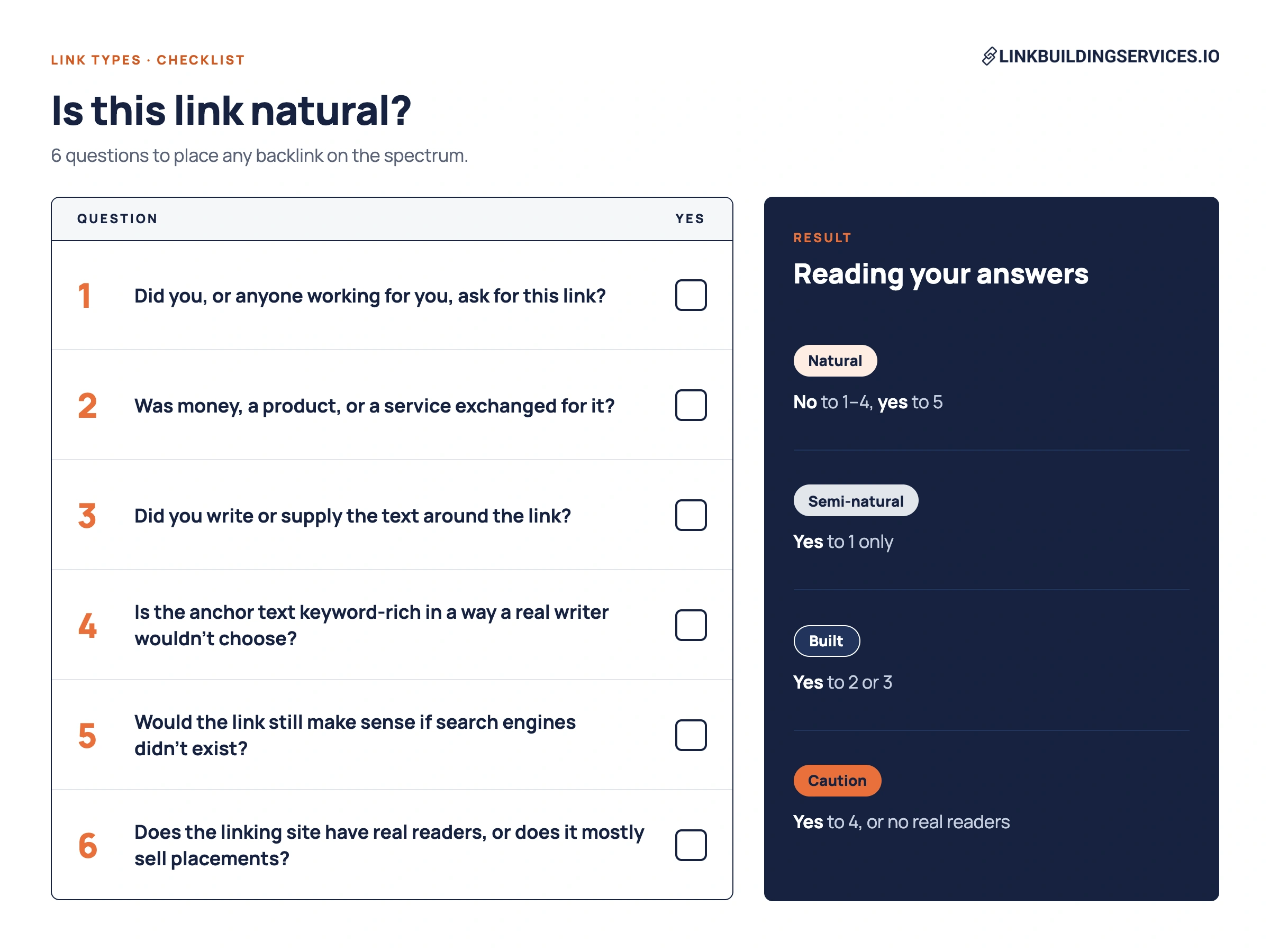
- Did you, or anyone working for you, ask for this link?
- Was money, a product, or a service exchanged for it?
- Did you write or supply the text around the link?
- Is the anchor text keyword-rich in a way a real writer wouldn’t choose?
- Would the link still make sense if search engines didn’t exist?
- Does the linking site have real readers, or does it mostly sell placements?
 How to Read Your Answers
| Your answers | Where the link sits |
|---|---|
| “No” to questions 1–4 and “yes” to question 5 | Natural link |
| “Yes” to question 1 only | Semi-natural. You asked, but the publisher still decided. |
| “Yes” to question 2 or 3 | Built link. Judge it by the site’s relevance, audience, and placement quality. |
| “Yes” to question 4, or a site with no real readers | Treat it with caution, whatever kind of link it is. |
If you’re deciding whether to pursue a new link opportunity, our ethical link building guide includes a five-question test built for that decision.
What a Natural Backlink Profile Looks Like?
Your backlink profile is the real full set of backlinks pointing to your site. Looking at single links tells you little, whereas looking at the entire backlink profile will help show patterns, and those patterns are what both Google and third-party link intelligence tools will pay attention to. If you need one, here are the best link building tools for checking your profile.
Here’s what a healthy, naturally grown backlink profile tends to have in common.
Varied Anchor Text Mix
Having a natural link profile is usually led by branded, topical anchor texts, with exact-match keyword anchors making up only a small share.
Mix of Followed and Nofollowed Links
Real profiles always include nofollow, UGC, and sponsored links, from web places like news sites, forums, social profiles, and comment sections. Social backlinks are a common example. Having this link profile where nearly every backlink is followed is pretty uncommon.
Links That Arrive in Bursts
Natural links don’t come in steady monthly quotas; in fact, they spike around real events like product launches, a study that gets press coverage, or a certain blog post that goes viral. Then, they settle down later.
Having a link graph that climbs at exactly the same rate every month rarely reflects how people actually link.
Topical Relevance With Some Variety
Most backlinks come from sites in or near your topic. But having a natural profile also has some unexpected ones, like links from a local news site, a university page, or a hobby blog in another country. Getting this real interest is rarely limited to one tidy niche.
Links Spread Across Many Pages
People would link to whatever helps them most. And that’s often your blog posts, tools, research, and guides, not only your homepage or sales pages. Having a backlink profile where almost every link points to a handful of commercial pages stands out, essentially. For how your homepage fits in, see homepage backlinks.
How to Earn Natural Backlinks (Grouped by Effort)
The reality is you can’t really force a natural link, but you can make your pages far more likely to get one. The link-building tactics below are grouped by how much work they take, with considerations and tips on why each one earns links. For more quick wins, see our list of easy backlinks.
Low Effort
Reclaim Unlinked Brand Mentions
Websites often mention your brand, product, or founder without linking. You can set up alerts in a tool like Alertmouse or Ahrefs, and then send a short, friendly note asking if they’d add your link.
Why it works: They already chose to talk about your stuff. Adding a link would help their readers find what they actually mentioned. Even mentions that stay unlinked still carry weight, as covered in brand mentions for seo.
Fix Broken Links Pointing to Your Site
Old URLs, deleted pages, and site migrations would leave some links pointing to error pages. You can find them with link intelligence tools and redirect each one to one of the most relevant live pages.
Why it works: These are backlinks you already earned. So having a redirect gets their value back without asking anyone for anything. See how to regain lost backlinks in ahrefs for the steps, and why use a backlink monitor tool if you’d rather catch lost links automatically.
Make Your Best Pages Easy to Cite
You can publish credible and solid statistics, publish dates, author names, and short, quotable definitions. Then, put key numbers near the top, where writers and publishers can easily find them.
Why it works: Writers would link to whatever is quickest to quote and easiest to trust.
Medium Effort
Templates, Checklists, and Free Tools
You have to build something people would use again and again: budget templates, hiring checklists, or simple calculators. You have to keep it free and easy to access.
Why it works: People share tools that would save them time, and they would link to them as resources in their own guides.
Expert Commentary for Journalists
You can answer journalist requests on expert-quote platforms like Qwoted, Featured, or #journorequest posts on social media. Be quick, specific, and genuinely useful when answering queries.
Why it works: Journalists genuinely need credible sources on tight deadlines. So having a strong quote often comes with a link to your site. It’s also one of the more reliable answers to how to get backlinks from high authority sites.
Glossaries and Reference Pages
You can pick the terms your audience searches for and write the clearest explanation of each one.
Why it works: When other writers use a term, they would link to a good definition instead of explaining it themselves.
High Effort
Original Research and Surveys
You can run a survey, analyze your own product data, or compile public data into something new. Then publish those findings with clear charts and a summary of key stats.
Why it works: New numbers would always give journalists and bloggers something to report on, and they link back to the source. If a popular study on your topic already exists, publishing a clearly better version is the idea behind skyscraper seo link building.
Annual Reports and Recurring Data
You can turn your research into a yearly report, like “State of [Industry] 2026”, and update it every year.
Why it works: Writers would come back each year for the newest figures, so your page gets to earn links as long as you keep it current.
Natural Backlinks and AI Search
More people now get answers from AI tools like ChatGPT, Perplexity, Gemini, and Google’s AI Overviews before they click a search result. That changes what being linked to means.
AI Tools Lean on What the Web Already Trusts
Pages that other sites repeatedly reference, such as original data, clear definitions, and expert explanations, are more likely to show up as sources in AI answers. The same qualities that earn natural links also make a page worth citing.
Brand Mentions May Matter More Than Before
AI tools learn which brands go with which topics partly from how often and where those brands are mentioned, linked or not. When your brand keeps appearing next to the right topics and competitors, that association grows. This is the idea behind co-citation link building.
What Tends to Get Cited
- Clear, quotable answers near the top of the page
- Original numbers with dates and sources
- Named authors with real expertise
- Up-to-date information
To check where you stand, ask AI tools the questions your customers ask and see which brands and pages they mention. No one can guarantee that a page will appear in AI answers, but earning citations and mentions on trusted sites is one of the most reliable ways to improve your chances.
Done for you
Want links that work alongside the ones you earn?
Tell us which pages you need to move. We’ll build links that fit your profile:
- Relevant sites and pages – not DR alone
- In-content, editorial placements – on pages with real traffic
- You approve every domain – before a single email goes out
Bottom Line
A natural backlink comes down to three tests: nobody paid, nobody traded, and nobody asked. Everything else sits somewhere on the spectrum, and semi-natural and built links can still be valuable when the site is relevant and the placement fits.
The most reliable way to earn natural links is to publish pages people need to cite, such as original data, useful tools, and clear explanations, then make sure the right people see them.
Written By

Reviewed By

Sef Gojo Cruz
COO at SharpRocket, overseeing end-to-end operations, from crafting link building strategies to leading high-performing teams. Previously led SEO initiatives at Workhouse, a digital agency in Australia, and Keymedia, a real estate media company based in New Zealand.