In enterprise link building campaigns, the constraint isn’t necessarily ideas. It’s actually legal sitting on a mention for weeks. It’s procurement taking two months to onboard a new vendor, and it’s the brand rejecting every single anchor text.
In this playbook, we cover the operational layer: how to define the threshold, structure the link building team, price the campaign against realistic link building packages, route around approval bottlenecks, prioritize target pages, and report those numbers your leadership cares about and actually acts on.
What enterprise link building actually is (and the threshold that makes it really “enterprise”)
Definition
Enterprise link building is the practice of acquiring backlinks at sustained volume for large organizations, where the work must pass through internal approval, brand, and procurement processes before it actually ships.
It differs from standard link building campaigns less in tactical view than in operating conditions: more target pages, more stakeholders, more compliance exposure, and link building reporting that has to satisfy both an SEO lead and a finance-led executive.
Running one of these already? See how our enterprise link building services plug into an in-house team.
Four Thresholds of Enterprise Link Building
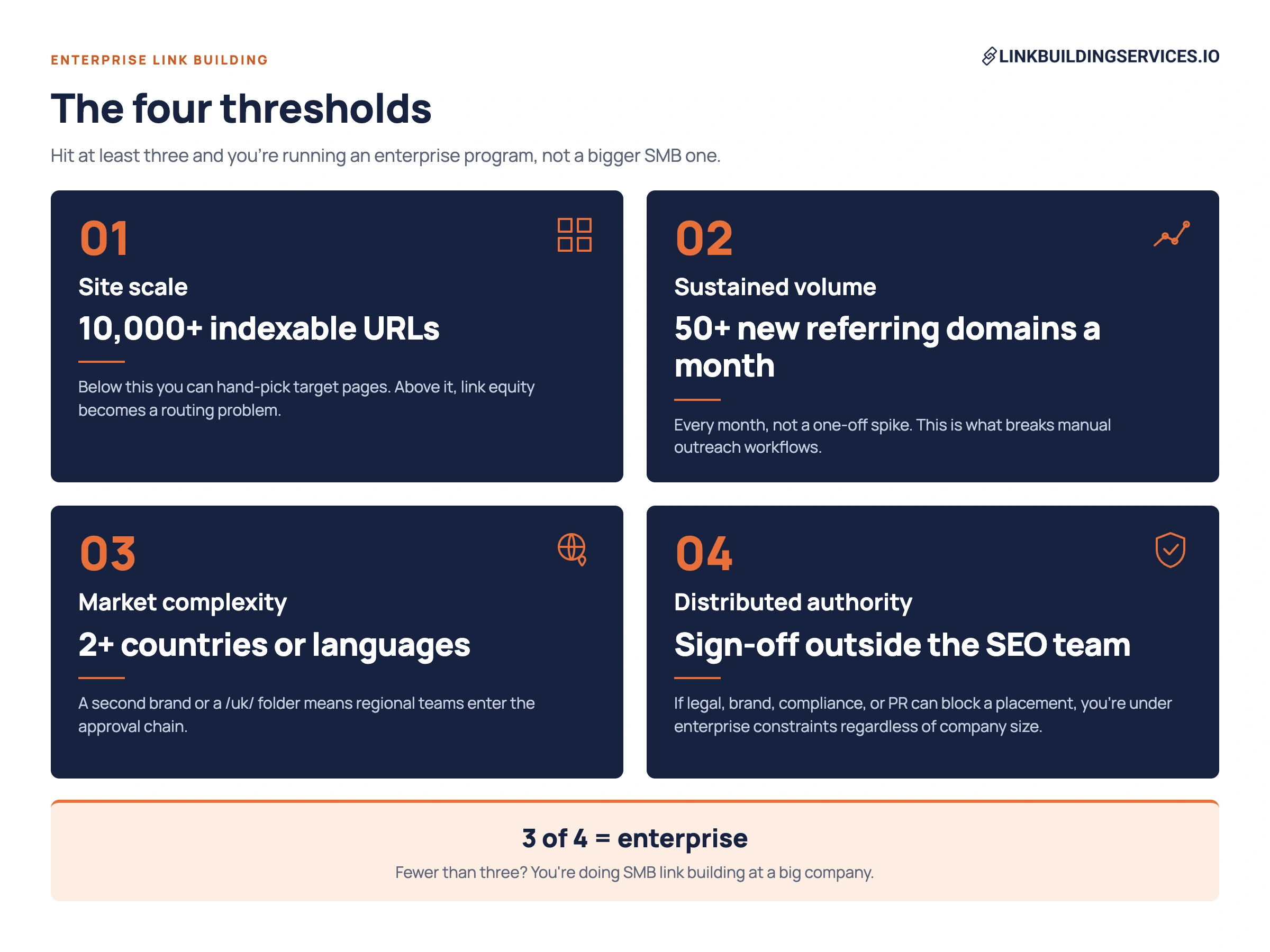
You’re running an enterprise link building campaign when at least 3 of these are true to your conditions:
1. Site scale – 10,000+ indexable URLs.
Below this, you can just hand-pick target pages. Above it, you need a prioritization model, given that link equity distribution becomes a routing problem.
2. Sustained volume – 50+ new referring domains per month, every month.
Not just a one-off link building campaign spike. A sustained volume is what truly breaks manual link building outreach workflows and forces you into either headcount or vendor capacity.
3. Market complexity – two or more countries, languages, or brand entities.
The moment you have a /uk/ folder or a second brand, knowing which page gets the link stops having that obvious answer, and regional SEO teams may enter the approval chain.
4. Distributed authority – link decisions require sign-off outside the SEO team.
If legal, brand, compliance, or PR can block any link placement decision, you’re operating under enterprise constraints regardless of your company size. For instance, a 200-person fintech company with a compliance review is more “enterprise” than a 5,000-person retailer where SEO ships unilaterally.
If you’re under all four, you’re doing SMB link building at a big company
This consideration really matters, given that the wrong diagnosis may waste budget. Plenty of large brands run link building campaigns that are structurally identical to a small business campaign: one owner, one target page set, one outreach vendor, no approval friction. They don’t need an enterprise operating model – they just need more backlinks.
Enterprise vs SMB Link Building
The table below is the fastest way to see whether your current link building campaign is actually built for the conditions you’re operating in.
| SMB link building | Enterprise link building | |
|---|---|---|
| Primary goal | Rank a handful of pages for a defined keyword set | Grow authority across page classes: categories, product lines, regional folders |
| Target pages | 5 to 20 pages, usually blog content plus one or two service pages | Hundreds of commercial pages, prioritized by a scoring model |
| Volume | 5 to 20 referring domains a month, often in bursts | 50 to 300+ referring domains a month, sustained |
| Approval path | Owner or SEO lead approves and ships same day | Legal, brand, compliance, PR, sometimes regional leads: 1 to 6 weeks per cycle |
| Anchor text control | Chosen by the SEO, adjusted freely | Governed by a brand-approved list; exact-match often restricted |
| Risk tolerance | Moderate. A bad link is a ranking problem | Low. A bad placement is a brand problem and a career problem |
| Content supply | The SEO or a freelancer writes it | Depends on a content roadmap you don’t control and didn’t set |
| Vendor onboarding | Credit card, start Monday | MSA, security questionnaire, procurement review before the first link |
| Reporting audience | The founder or marketing manager, monthly | Two readers: SEO leadership and executives, with different questions |
| Time to visible impact | 8 to 12 weeks | 4 to 6 months, compounding through months 6 to 18 |
| Failure mode | Not enough backlinks | Plenty of links, none approved, aimed at the wrong pages |
These are three considerations to help you decide your operating model:
Approval path. Every downstream decision here, whether that’s a vendor choice, a link building tactic mix, or whether your team wants to run branded or unbranded campaigns, traces back to how long your approval cycle is and who actually owns it.
Content supply. SMB link building assumes you can produce the linkable asset on demand. With enterprise, you usually can’t. Your content team has a quarterly roadmap set by someone else, so campaigns that depend on internal content production stall.
Reporting audience. SMB reporting only has one reader, while enterprise reporting has two or more stakeholders. You need to explain the same report to both a CFO and an SEO director, and they require different sets of decisions.
Five constraints nobody warns you about in enterprise link building
Backlinks don’t just lose at the outreach campaign phase. In fact, they die waiting in one of these:
1. Legal and compliance review
In regulated verticals like finance, insurance, or pharma – and especially in link building for healthcare, where medical claims carry their own review layer – any external content that describes what your product does gets reviewed before it even goes live.
Examples of these are guest posts, data studies, and quoted expert commentaries, which are all public claims about the company, and legal treats them that way. The same pattern shows up in link building for lawyers, where bar advertising rules add a reviewer who has never seen an outreach email.
Two ways you can attack this. First, through cycle time: budget a couple of days to weeks per review round, and expect at least one round of revisions. Second, remember the reviewer isn’t optimizing for your KPI, so a vague, hedged, claim-free version of your asset will always be the safer approval.
2. Brand and PR
Brand controls the narrative, PR may control the publisher relationships, and neither of them reports to you.
Pro Tip
Get the blocklist in writing before you prospect, not after you’ve landed a placement. And get PR’s existing media relationships mapped, given that the outlets they already have warm contacts at are the cheapest backlinks in your entire link building campaign.
3. Procurement
If you’re hiring a link building vendor, the first backlink is 2 to 4 weeks away before anyone will send an email: MSA negotiation, security questionnaire, data processing agreement, vendor risk review, PO issuance. And in some organizations, you can add competitive bid requirements: three quotes on file before you’re allowed to shortlist the best link building services for the account.
You may start procurement in parallel with vendor evaluation rather than after picking one. And ask any shortlisted agency directly whether they’ve completed enterprise security questionnaires before.
4. Anchor text and brand-safety governance
At SMB scale, your SEO team picks the anchor text. At enterprise, the strategy for choosing anchor texts is usually governed: a brand-approved list, restrictions on exact-match commercial phrases, and rules about which product names can appear in which contexts. Legal may have opinions about superlatives, or trademark may have opinions about how the brand is actually written.
All these constraints limit tactics more than people expect, and any tactic that depends on winning an exact-match anchor to a money page is fighting your own governance.
5. Cross-department ownership
Enterprise link building activities are mostly a coordination job wearing an SEO job’s title, so you really have to name an owner for each dependency and get it acknowledged in writing.
Workaround: Sequence unbranded campaigns first
Here’s a workaround that gives you a two-track approach for a link building campaign:
Track A – unbranded. Run it continuously, ship it without any approval friction, and build those referring domains to category and resource pages. This is what keeps velocity steady during the months when everything branded is stuck in review.
Track B – branded. Digital PR, executive commentary, product-led studies. These are higher value per link placement, and they’re also where unlinked brand mentions for SEO pile up fastest, so build a reclamation step into the track.
Say this out loud to your team
This workaround is a sequencing tactic, not a compliance workaround. If your industry has disclosure obligations, unbranded content doesn’t exempt you from them, and anything designed to conceal a material relationship is an entirely different thing. Those unbranded assets still need to be genuinely useful.
How to structure the link building campaign: in-house, agency, or hybrid
Whether it’s five SEO professionals, two people wearing multiple hats, or a vendor, the functions don’t change much:
| Role | What they own | Realistic capacity |
|---|---|---|
| Program owner | Strategy, page prioritization, stakeholder management, reporting | 1 per campaign. This role cannot be outsourced |
| Prospector | Publisher sourcing, qualification, vetting against brand blocklists | 300 to 800 qualified prospects a month |
| Outreach specialist | Pitching, negotiation, follow-up, placement confirmation | 15 to 40 placements a month |
| Content producer | Linkable assets, guest drafts, data studies | 2 to 6 assets a month depending on depth |
| Analyst | Link gap analysis, velocity tracking, attribution, dashboards | 1 across the whole campaign |
Pro Tip
The number most teams get wrong is outreach capacity. One skilled outreach specialist lands roughly 15 to 40 placements a month. If your target is 150 backlinks a month, that’s four to six people on outreach alone, before prospecting or content. Do this arithmetic on paper before anyone debates in-house versus agency.
Decision table
| In-house | Agency | Hybrid | |
|---|---|---|---|
| Volume ceiling | Low to moderate, capped by headcount | High, scales with retainer | High |
| Cost at 100 links a month | Highest all-in | Lowest per link | Middle |
| Time to first backlink | 3 to 6 months (hiring plus ramp) | 2 to 4 weeks (procurement) | 2 to 4 weeks |
| Internal access | Full. Knows the roadmap and the politics | None. Dependent on your briefings | Full, via the in-house owner |
| Brand risk control | Highest | Depends on vendor vetting standards | High, if guardrails are set upfront |
| Institutional knowledge | Stays | Leaves with the contract | Stays with the owner |
| Best for | Highly regulated, brand-sensitive, moderate volume | High volume, clear target pages, competent internal owner | Most enterprises above the four thresholds |
What works with a hybrid split: in-house owns strategy, prioritization, approvals, and reporting. The vendor providing your enterprise link building services owns the main initiatives: prospecting, outreach, and content production.
You just keep the judgment calls inside and buy the capacity outside – the decision to outsource backlinks is a capacity call, not a strategy one. Link building campaigns fail when this inverts and the agency is quietly setting strategy, given that nobody internal has the time or resources to make it work.
Built for in-house SEO teams
Don’t have the headcount to run this program yourself?
Send us your target pages and your brand guardrails. We run prospecting, outreach, and content production at enterprise volume, and you keep strategy, approvals, and the reporting your leadership signs off on.
✓ Links to money pages, not just blog content
✓ Publisher vetting against your brand blocklist
✓ Anchor governance and an unbranded track for compliance-heavy verticals
✓ Stakeholder-ready reporting for SEO leads and executives
See Enterprise Link Building Services →
Trusted by enterprise brands and in-house SEO teams · No obligation
Which pages get backlinks first: a prioritization framework
At 10K+ URLs, you need to know how to route link equity. Choose pages that make money for the business and require the most authority: category pages, product and solution pages, service pages, and high-intent comparison pages. These are also the exact pages competitors are actively building links to, which is precisely why they’re difficult to win with content alone.
A workable default at enterprise scale:
- 50 to 60% to commercial pages like category, product, solution, and regional equivalents
- 25 to 30% to hub and resource pages that link internally to those commercial pages
- 15 to 20% to linkable assets whose job is to earn links, then pass equity internally
Scoring Model
You need to score every candidate page on four inputs and rank them by the product. Do this quarterly.
| Input | What you’re measuring | Scale |
|---|---|---|
| Commercial value | Revenue or pipeline attributable to the page, or conversion rate times traffic potential | 1 to 5 |
| Rank proximity | Current position. Positions 4 to 15 score highest, since that’s where backlinks move the needle fastest | 1 to 5 |
| Link gap | Referring domains to the top 3 competing URLs minus yours | 1 to 5 |
| Authority ceiling | Internal link support, content quality, technical health. Can this page hold a higher rank if given authority? | 1 to 5 |
Priority score = Commercial value × Rank proximity × Link gap × Authority ceiling
When you multiply intentionally, it zeroes out pages that fail on any single dimension, like a page with huge commercial value but a broken authority ceiling.
Two guardrails
Cap per page. No single URL takes more than ~15% of monthly link volume. Concentration may look unnatural and will produce diminishing returns fast; the same link building best practices that govern velocity at SMB scale still apply here, just across more pages.
Re-score quarterly. Rank proximity changes. A page that moves from position 12 to position 3 should drop out of the queue and free budget for the next one.
Hubs, product lines, and regional folders
Another consideration is these three structural patterns that are worth handling explicitly:
Hub pages beat leaf pages when the leaf set is large. Let’s say you have 200 near-identical product pages. Don’t simply chase links for each. You can build authority into the category hub and make sure it links cleanly to every leaf.
Product lines get separate budgets, not one shared pool. Start allocating by revenue contribution, publish the allocation, and let the scoring model handle the sequencing within each line.
Regional folders need regional links. Regional pages must get scored in their own queue against their own local competitors.
Multi-market and multi-language link building
The instinct for most SEOs is to take a link building campaign that worked in the US, translate the pitch, and send it to German publishers. It may underperform badly for reasons that have nothing to do with translation quality.
For instance, the German SEO and marketing web ecosystem has different dominant outlets, different link conventions, and a markedly lower tolerance for anything that reads like an outreach email. Japan may run heavily on corporate media and industry associations rather than independent blogs. Latin American markets may have strong regional news but thin independent publisher layers. France has an active blogging scene but expects real relationships before any genuine links. All of these you have to factor in when doing multilingual link building campaigns.
A couple of link building tips here:
Source natively, not by translation. Start building the prospect list from local SERPs and local industry associations, and steal your competitors’ backlinks in that region, because their regional profile is the fastest map you’ll get of what the link ecosystem actually looks like there.
Staff native speakers for outreach, not translators. Translated pitches may be read as translated pitches, and the outreach response rate here may be starkly different.
Adjust the tactic mix per market. Local media will cover data studies if you cut the data by their country; the guest posting vs niche edits balance shifts enormously by market, and broken link building works everywhere. All these require adjustments at the tactical level.
Localize the data, not just the language. One same study can be cut into per-country figures, which gets covered in six markets, given that each outlet has a local number to lead with.
hreflang clusters and where the link should land
Let’s say a French publisher links to your English page. Does the French page benefit?
The answer is partially, and unreliably. hreflang tells Google these pages are alternates of each other, but it doesn’t consolidate link equity the way a canonical does. So you have to treat authority as accruing per URL, with some cluster-level brand benefit, and you need to plan it accordingly.
Three rules to consider here:
Point regional links at the regional URL. Let’s say a backlink from a German publisher should land on /de/, not on the .com root. Regional publishers are where your niche relevant backlinks come from in that market, and sending them to the English page throws away the strongest signal you’ll get.
Audit hreflang before you spend on regional links. Broken or non-reciprocal hreflang tags are pretty common at enterprise scale, and building links into a broken cluster can mean paying to strengthen a page Google may be filtering or swapping incorrectly. Validate that first, as it’s a one-week check that will protect a year of budget.
Homepage backlinks are the exception here. Brand-level coverage may naturally point at the root domain, which is fine and useful, but don’t contort a PR placement into a deep link where it doesn’t belong.
Centralized vs federated link building campaign models
How you organize your campaigns across regions matters as much as tactics.
| Centralized | Federated | Hub-and-spoke | |
|---|---|---|---|
| Structure | One global team runs all markets | Each region runs its own campaign | Global sets standards and budget, regions execute |
| Quality consistency | High | Variable | High |
| Local relevance | Weak | Strong | Strong |
| Reporting | Unified | Fragmented, the hardest problem in federated models | Unified |
| Speed | Slow, the global team becomes the bottleneck | Fast | Moderate |
| Best for | 2 to 3 markets, similar languages | Regions with genuine P&L autonomy | Most enterprises with 4+ markets |
The default recommendation really is hub-and-spoke. Global owns the standards like publisher quality criteria, brand blocklist, anchor governance, reporting schema, and vendor contracts. Regions actually own execution, such as prospecting, outreach, local relationships, and market-specific tactics.
It’s measurement you have to watch out for here. You have to standardize the reporting schema on day one, even if you decentralize everything else.
Pro Tip
Don’t launch all markets simultaneously. Prove the model in one non-English market first, ideally your second-largest by revenue, and use it to calibrate cost per link, response rates, and cycle time before rolling out.
Regional cost per link may often run 20 to 50% above US benchmarks in low-supply markets and below it in others, so re-answer how much do backlinks cost per market rather than extrapolating from your US rate. You really want real numbers before you commit to a global budget.
Written By

Reviewed By

Sef Gojo Cruz
COO at SharpRocket, overseeing end-to-end operations, from crafting link building strategies to leading high-performing teams. Previously led SEO initiatives at Workhouse, a digital agency in Australia, and Keymedia, a real estate media company based in New Zealand.