Every week, your inbox gets at least one flattering email that says, “I read your article and thought it would be a great fit for…” – most are merely link swap requests. Some actually lead to genuinely useful additions to your content.
Swapping links means two or more website owners agree to link to each other’s content.
Done right, each backlink sits on a topically related page, appears where their readers actually need it, and reads like a natural editorial choice. Done wrong, it’s like a link scheme that search engines simply discount and their readers would ignore.
In this guide, I’ll show you how to judge each link for swap links, and show you two real swap requests I received for one of my web properties.
In This Article
- What Swapping Links Actually Means
- Where Google Draws the Line
- Why Google Ignores Many Swapped Links
- Editorial Test: Would You Link Without the Swap?
- Topical Relevance at Three Levels
- Context: Placement, Surrounding Words and Anchor Text
- Two Real Swaps, Judged Side by Side
- How to Evaluate a Swap Request: Checklist
- Free Download: Link Swap Scorecard + Toolkit
- How to Run a Swap Step by Step
- Tracking and Monitoring Swaps
- Red Flags: When to Say No
- Better Alternatives (and Complements) to Swaps
What Swapping Links Actually Means
Link swaps come in a few forms, and their type changes how a swap looks to both search engines and to readers.
| Swap type | How it works | Example |
|---|---|---|
| Direct (reciprocal) | Site A links to Site B, and Site B links back to Site A. | A training blog and an LMS review site link to each other’s guides. |
| 3-way (ABC) | Site A links to Site B, and a third site (C), usually owned or managed by B’s partner, links back to A. | An agency asks you to mention their client, then places your link on one of its partner sites. |
| Content mention swap | Each side adds a contextual mention inside an existing article. | You add a tool to your roundup, and they cite your guide in a related post. |
| Guest post swap | Each side writes a full article for the other’s site, with a link back. | You write about course design for their blog, and they write about learner engagement for yours. |
Content mention swaps work much like link insertions, while guest post swaps follow the guest posting model. If you’re unsure which format suits a partnership, see guest posting vs niche edits.
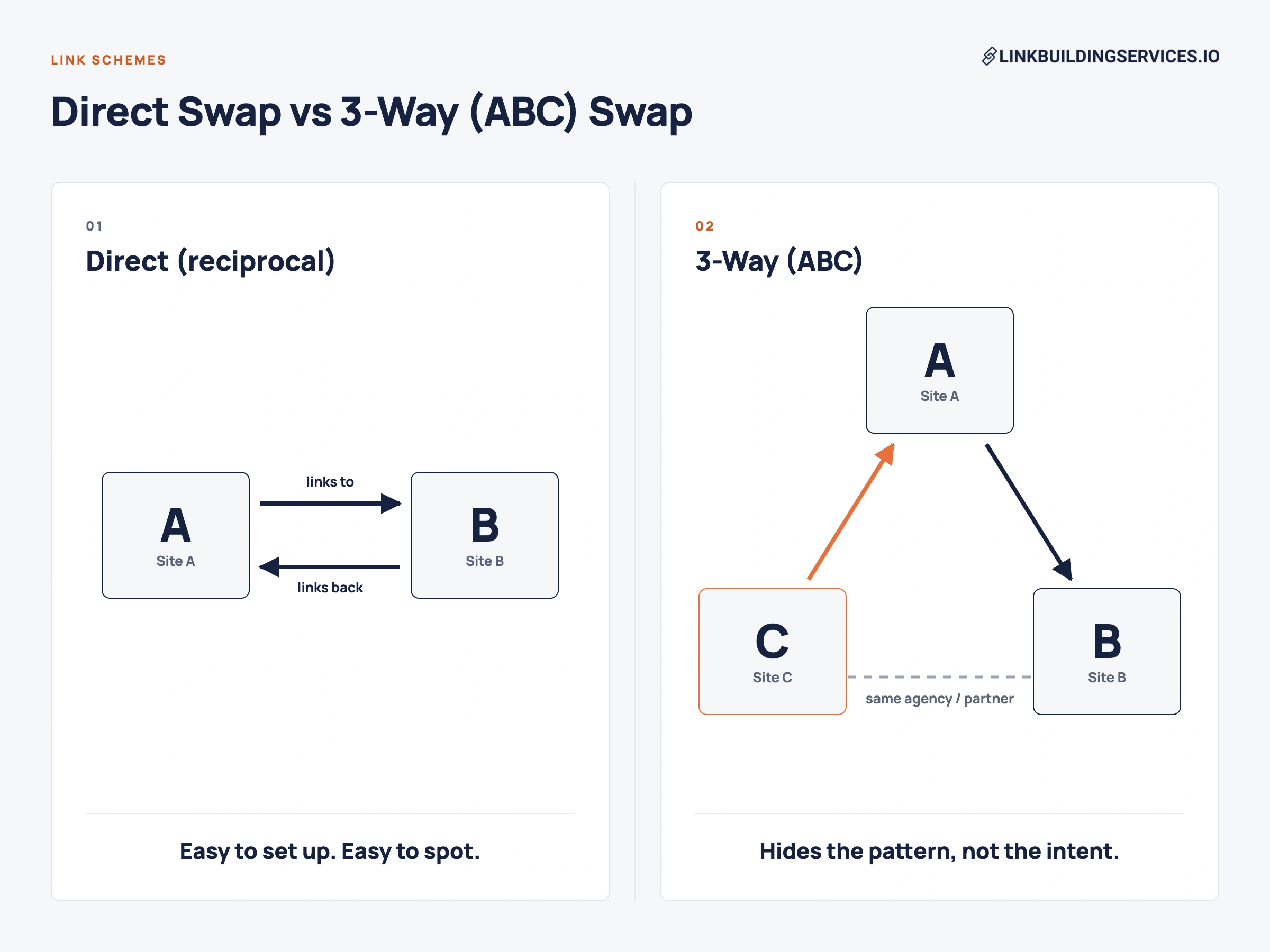
Direct swaps are the simplest form, but often the back-and-forth pattern is also the easiest to spot. A 3-way swap can break that pattern, which is why agencies mostly prefer it.
What Doesn’t Count as a Swap?
If any money changes hands, it’s considered a paid placement. One outreach email I received offered to “feature you on one of our partner sites” or “discuss a paid collaboration” – the first is a swap. The second is essentially advertising. If you’re weighing paid options, our guide on how much do backlinks cost covers typical rates.
Where Google Draws the Line
Google’s position on link swaps is often misread in both directions. Some would say any swap will get you penalized; others would often say anything goes – actual policy sits in between.
Google’s spam policies define link spam as creating links to or from a site primarily to manipulate search rankings. And among the listed examples are excessive link exchanges (“Link to me and I’ll link to you”) and partner pages that exist purely for cross-linking.
Two words in that policy do most of the work:
- “Excessive” – the link policy doesn’t ban every mutual link. In fact, many reciprocal links happen naturally when related sites reference each other. Deliberate, excessive exchanges arranged to boost rankings are what Google treats as link spam.
- “Primarily” – intent here matters. A backlink added because it genuinely helps your reader is different from a link that’s just added because someone promised one back.
An example of this would be an ABC swap that hides the obvious back-and-forth pattern, but it doesn’t really change the intent. If the backlink only exists because of the deal, a third site in the middle doesn’t make it purely editorial.
When a link swap crosses the line, the usual outcome isn’t dramatic. Most link spam is simply devalued rather than penalized – so a manual action is the rare, worst case; after all, the backlink here just stops counting. That’s why we treat relevance and reader value as non-negotiable in ethical link building.
Why Google Ignores Many Swapped Links
Being “allowed” and being “counted” are actually two different things. A link swap can stay well inside Google’s policy and still pass almost no value.
Cyrus Shepard recently summarized what makes Google weight a link more heavily in his guide How To Create Links for SEO Google Can’t Ignore, drawing on Google patents and the 2024 API documentation leak. In his reading, Google gives more weight to links that:
- Show relevance
- Come from a trusted source
- Add new or unique information
- Come from independent editorial decisions
A link swap fails the fourth criterion by design – the link exists partly because of a deal, not purely because an editor chose it. And that puts more pressure on the other three. It’s also why swapped links rarely match the value of natural backlinks.
So a swapped link that’s only loosely relevant, comes from a weak website, and repeats what other links already say has very little working in its favor.
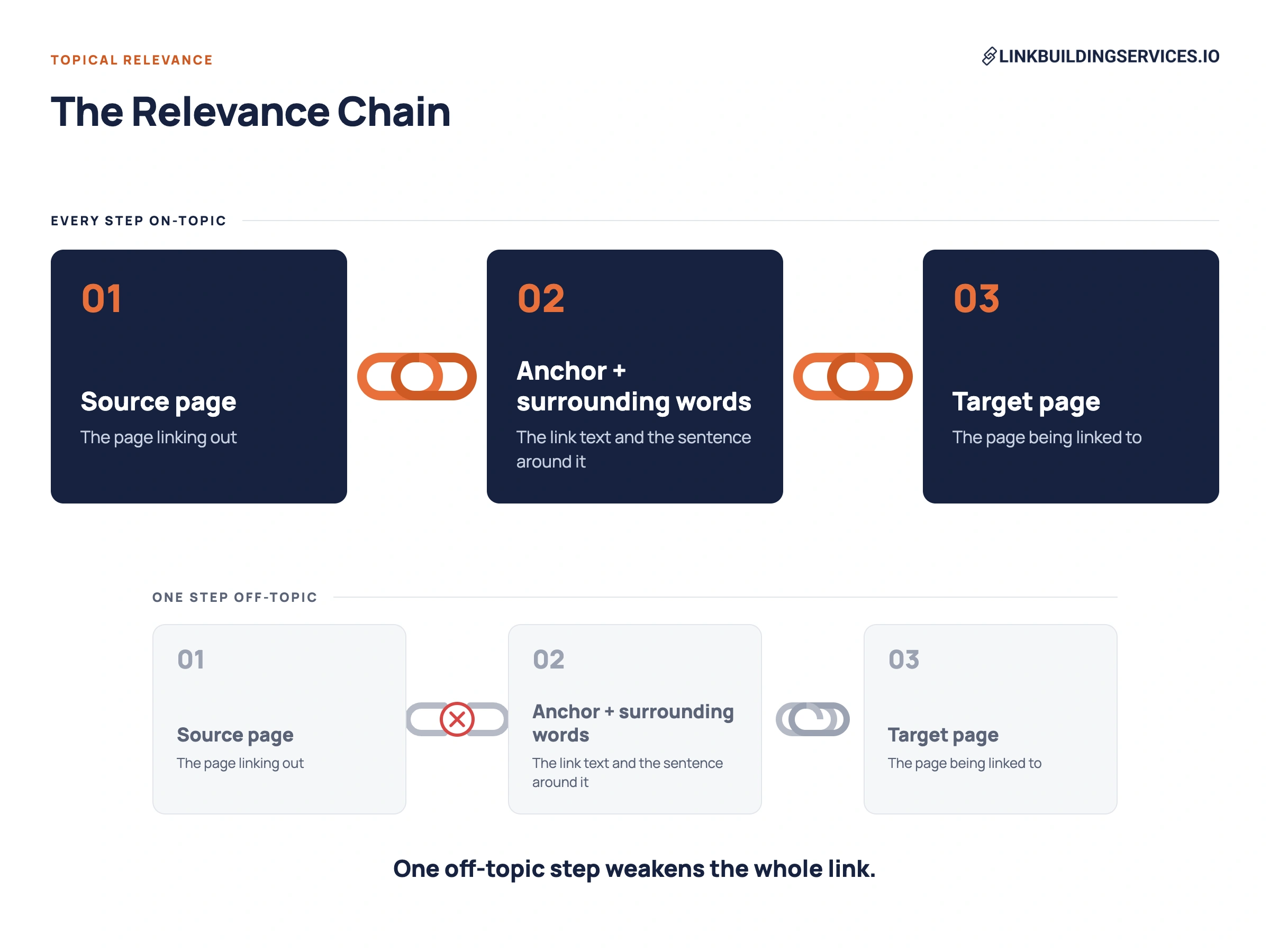
Cyrus frames relevance as a chain: source page → anchor text and surrounding words → target page. Now if any link in that chain isn’t topically related, the whole link weakens. I find that the link chain is one of the most useful single tools for judging a link swap, and I use it throughout the rest of this guide – if you’ll notice.
Editorial Test: Would You Link Without the Swap?
Before I agree to any swap, I typically ask one question: if they offered nothing in return, would this link still belong in my article?
If the answer is yes, the link swap is just a convenient way to make a connection that already made sense. If the answer is no, no amount of clever wording or third-party placement will actually fix it.
To answer honestly, I run every request through these three filters.
- Topical relevance – is the linked page about the same subject as the page I’m adding it to? This is a page-level check, not a site-level one.
- Context – is there a specific passage where a reader would naturally want this link? If I have to write a new sentence just to create a reason for the link, it doesn’t really fit. Bridge sentences like “once you’ve chosen your tool, the next challenge is…” usually mean the backlink is being forced in.
- Reader value – does clicking the backlink help the reader finish what they came to do? Someone reading an LMS roundup is comparing platforms, and one more credible LMS helps them. A backlink to an unrelated service can pull them away from their goal.
A backlink should pass all three. If it fails one, I don’t just say no. I look for a better pairing first, and decline only if there isn’t one.
Topical Relevance at Three Levels
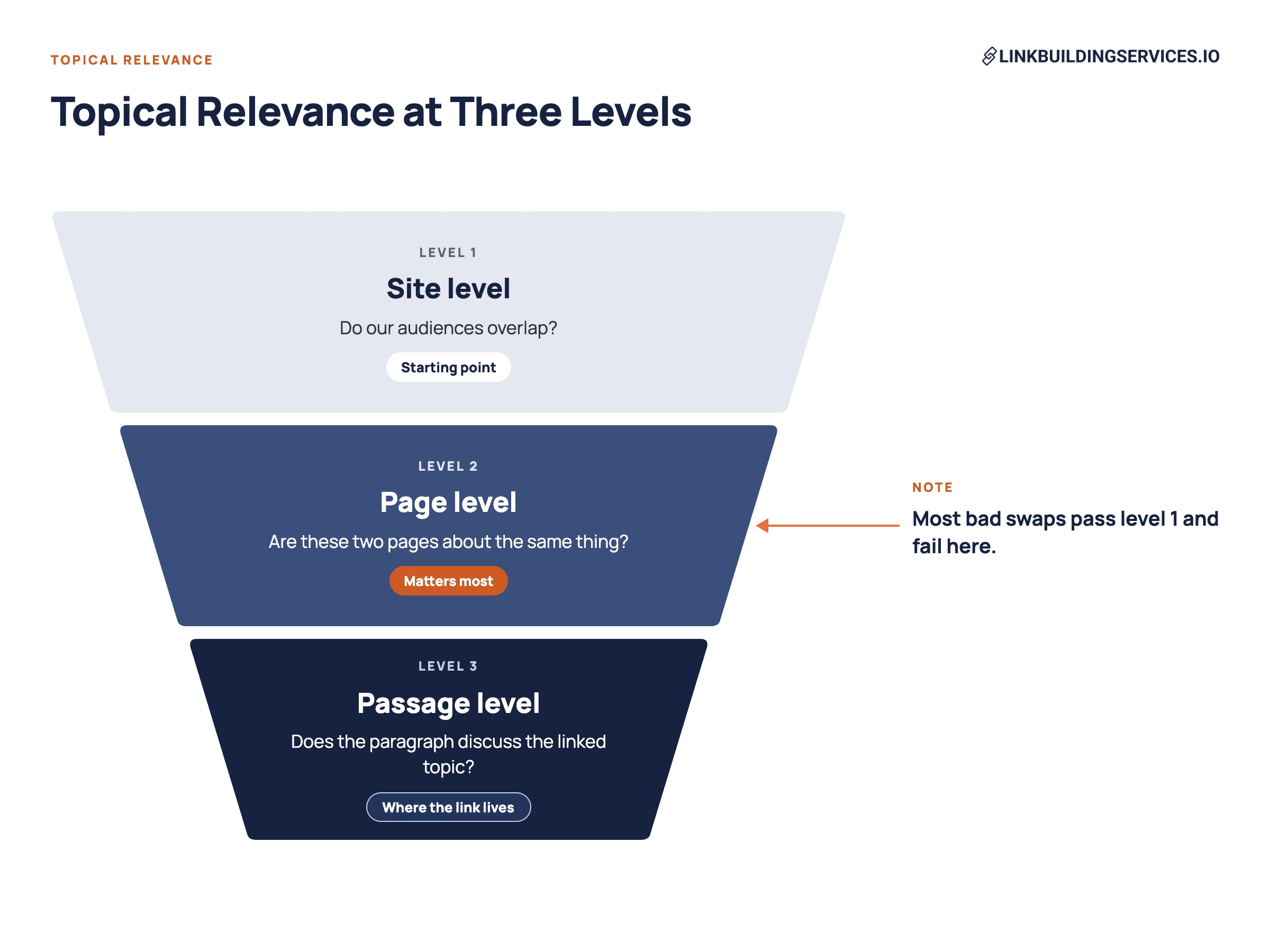
Almost every pitch I receive says the other site “closely aligns” with mine. To truly test that claim, I check topical relevance at three levels. (For why relevance outweighs raw authority, see niche relevant backlinks.)
-
- Site level: do our audiences overlap? An example would be an L&D consultancy, an LMS vendor, and an instructional design blog, all of which serve people who build or manage training – it’s the starting point, not really the deciding factor. Most bad swaps would pass this check and fail the next one.
- Page level: are these two pages about the same thing? This really matters most, and the question isn’t “are we in the same industry?” but “would a reader of this page benefit from that page?”
- Passage level: does the paragraph discuss the linked topic? Even with a strong page match, the backlink needs a home in a section that already covers the subject.
Example Pairing Matrix for an eLearning Blog
| My page | Their page | Fit | Why |
|---|---|---|---|
| Best LMS for training companies | An LMS vendor’s product page | Strong | Same decision, same reader |
| Best LMS for training companies | LMS implementation checklist | Strong | Natural next step after choosing |
| Best eLearning authoring tools | SCORM vs xAPI explainer | Strong | Readers choosing tools need to understand standards |
| Best eLearning authoring tools | Course template library | Good | Directly supports building courses |
| Best eLearning authoring tools | Backlink outreach software | Weak | Different job, different reader intent |
| Instructional design models | Corporate training budget guide | Loose | Same audience, different question |
A weak pairing doesn’t always mean the partnership is wrong – often the sites match, but the chosen pages don’t. For instance, if an agency’s client sells course design services, a link from my instructional design guide might work far better than one from my tools roundup. Proposing a better pairing would usually beat forcing the original request.
Context: Placement, Surrounding Words and Anchor Text
A relevant backlink can still look forced and pass less value if it’s placed badly.
Placement: High in the Body, Where Readers Need It
The strongest link placement is actually in the main body, inside the section that covers the linked topic and ideally not buried at the bottom. Google’s “Reasonable Surfer” thinking would give more weight to links people are more likely to click, and links in the main content are clicked far more than boilerplate.
Link placements to avoid:
- Footers, sidebars, widgets, and author bios – these repeat across pages and look like site-wide deals.
- Tacked-on “resources” lists that can grow one swap at a time.
- Separate partner pages built only to hold swapped links.
Surrounding Words: Treat Them as Part of the Backlink
Most people obsess over anchor text and ignore the sentence around it. According to Shepard’s analysis, Google can record the terms immediately before and after an anchor and use them to understand context. Backlinks with thin or repetitive context tend to carry less weight.
And that changes how you should write the insertion. Compare:
- Thin – “Another option is [Vendor].”
- Rich – “For training companies that sell courses to external clients, [Vendor] combines an LMS with built-in ecommerce and client-specific portals, which removes the need for a separate storefront.”
The second version tells readers and search engines exactly why the backlink is there.
Partners often send ready-made text to paste in. One described a tool as earning backlinks “on autopilot” – that’s ad copy. I always rewrite supplied text to match the page:
- Use the same tone and format as the other entries
- Add something that’s specific: feature, use case, or limitation
- Remove claims you can’t verify
- Keep it proportionate to the other items on the page
Anchor Text: Describe, Don’t Engineer
| Anchor type | Example | Risk |
|---|---|---|
| Branded | “[Vendor]” | Low |
| Descriptive | “this guide to SCORM packaging” | Low |
| Partial match | “[Vendor]’s LMS for corporate training” | Low to moderate |
| Exact-match commercial | “custom elearning development services” | Higher, especially when repeated |
The classic advice here is to rotate anchor texts across a set percentage mix of exact, partial, and branded phrases. Cyrus points to Google patents describing the detection of “deliberately different anchors” – slight variations of the same money phrase built over a short period. Simply rotating synonyms doesn’t really hide the intent after all.
A better approach is for each anchor to describe what that specific link offers. Let’s say you’re requesting links back from several link swaps – don’t just ask for “elearning development,” “elearning development company,” and “custom elearning services” in turn. Let each partner describe what they’re actually pointing to. Our link building best practices cover anchor and placement guidelines in more detail.
Keep Each Link Unique
Cyrus also notes Google discards most repeated anchors from a single domain. Sitewide or templated links add little. A well-placed backlink in a relevant article is worth more than the same link repeated across a site, so keep each swap to one link on each side.
Two Real Swaps, Judged Side by Side
Here are two link swap requests I received for our blog at eLearning Solutions Lab; we run them through the topical relevance chain.
Example 1: An LMS Vendor in My LMS Roundup (Strong Fit)
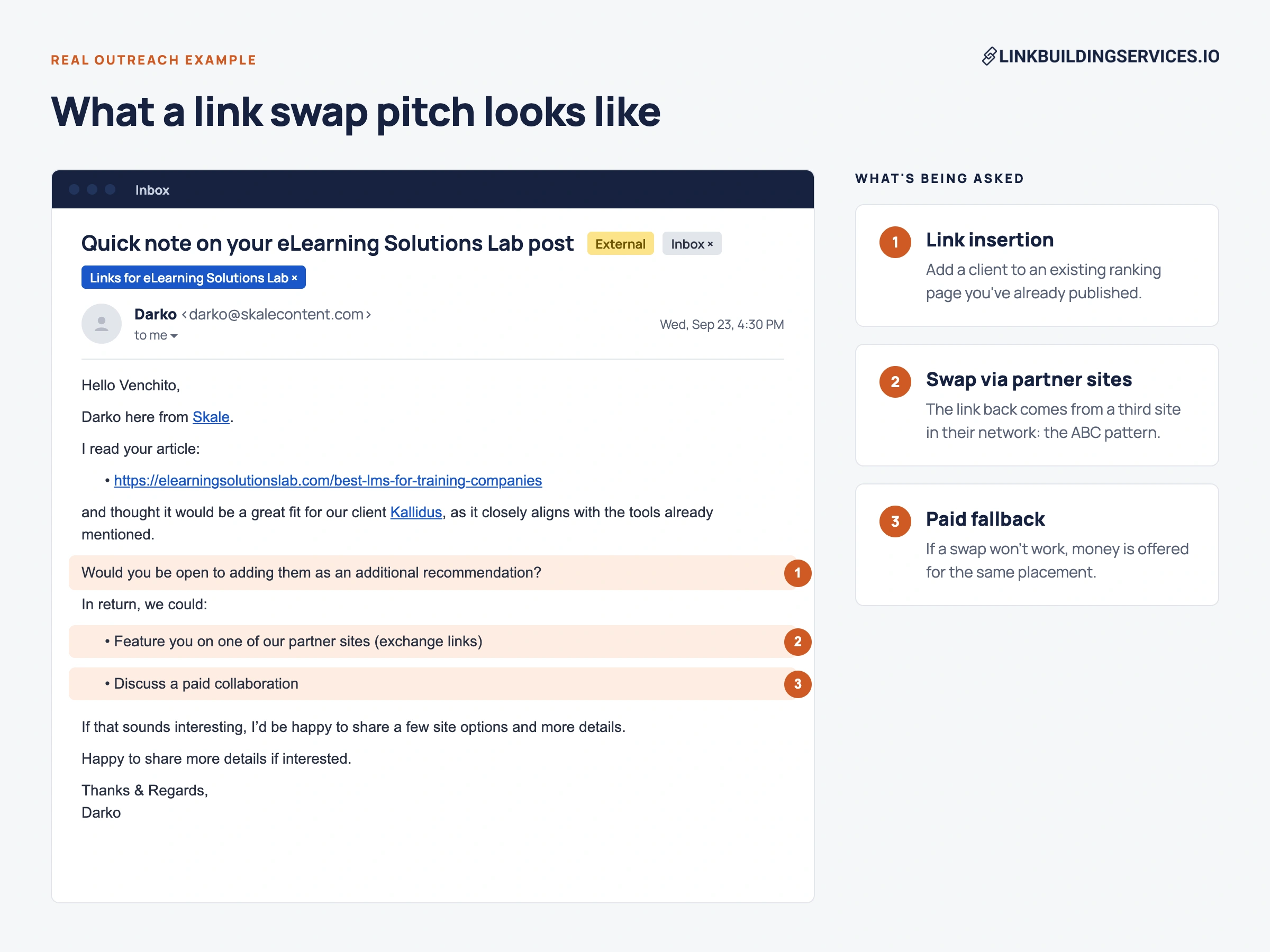 An agency contacted me about my article on the best LMS platforms for training companies. They asked me to add their client, an LMS vendor, as an additional recommendation. In return, they’d place a link to my site on one of their partner sites.
- Source page – an LMS roundup for training companies
- Anchor and context – the vendor’s name in a new entry alongside the other platforms
- Target page – an LMS product
Every step of the chain matches. Readers comparing LMS options get one more relevant option. I’d plausibly have added this vendor on my own.
The process was clean too. They placed my link first, I verified it, and only then did I add theirs.
The one point to check with ABC swaps like this is the partner site. It should be a real site with its own audience, not one of dozens of sites that the agency maintains to hand out links.
Example 2: An Outreach Tool in My Authoring Tools Roundup (Forced Fit)
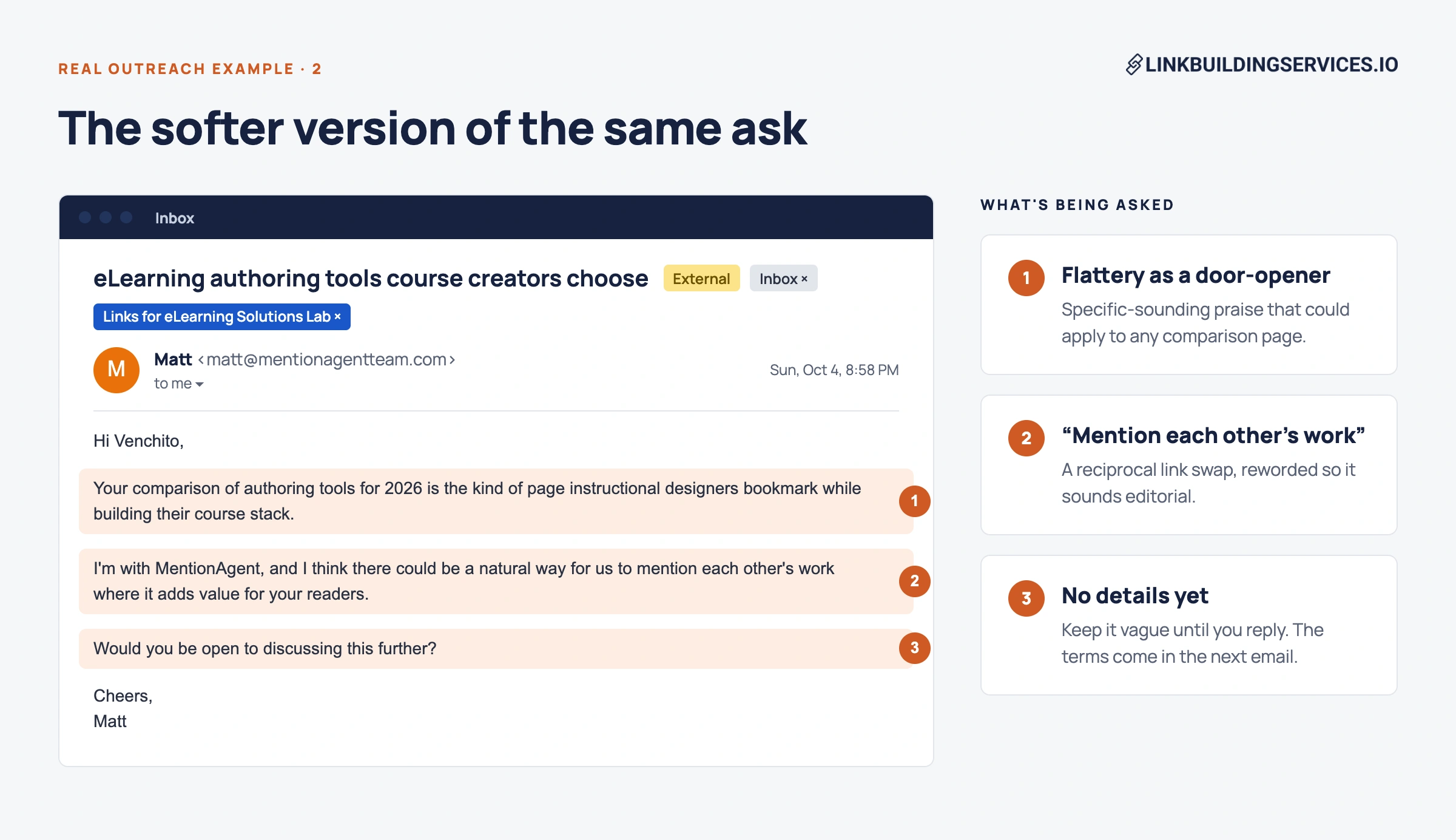 A different company proposed a content mention swap. They’d add a link to my site on their glossary page about agentic outreach, using the anchor “custom elearning development services.” In return, I’d add a paragraph to my eLearning authoring tools comparison, linking to their article on backlink builder software with the anchor “outreach automation tool.”
On their side:
- Source page – a glossary entry about outreach automation
- Anchor – a commercial eLearning phrase
- Target page – my eLearning site
- The source page has nothing to do with eLearning, so the topical chain breaks at the first step.
On my side:
- Source page – an authoring tools comparison
- Anchor and context – a bridge paragraph saying course creators’ next problem is getting their content seen
- Target page – link building software
Again, the topical chain breaks. Readers choosing an authoring tool aren’t necessarily looking for SEO outreach software, and the supplied paragraph exists only to justify the link.
The better move here would have been to look for pages that actually match, or to decline.
Takeaway
Both swaps used similar mechanics. One produced a backlink I’d defend to my readers. The other produced two links that help neither audience and likely pass little value. Essentially, topical relevance made the difference.
How to Evaluate a Swap Request: Checklist
Before you agree to link swaps, you need to check:
- Website – real, with genuine traffic and an audience close to yours (our guide on how to analyze blogger for link building and outreach strategies walks through the full vetting process)
- Page – about the same subject as your page
- Passage – a section in your article where the link naturally belongs
- Anchor text – branded or descriptive, not just an engineered keyword
- Partner website (ABC swaps) – not part of a network built for link placements
- Volume – link swaps remain a small share of your links this quarter
- Editorial test – you’d add this link even without anything in return
Free download
The Link Swap Scorecard + Toolkit
Score every swap request before you say yes. You’ll get a 13-page PDF scorecard and a Google Sheets toolkit with:
- An 8-question knockout screen and a 12-point editorial-fit scorecard
- Automatic accept, counter-propose, or decline recommendations
- Both real swap examples from this guide, scored in full
- A swap tracker with 30-day link checks and six reply templates
Scorecard by LinkBuildingServices.io (SharpRocket). We’ll email you both links.
How to Run a Swap Step by Step
- Agree on both pages first – confirm the source and target page on each side before anyone writes anything.
- Agree on anchors and placement – branded or descriptive anchors, placed in the main body.
- Partner goes live first, or both sides publish the same day.
- Verify their link – check that it’s live, indexable, uses the agreed anchor, isn’t hidden, and has the right attribute. New links can take time to appear in third-party tools, as explained in backlinks not showing up in ahrefs.
- Write your insertion in your own voice and publish it.
- Confirm by email and log the swap.
One more thing to agree on: neither side should later redirect, merge, or repurpose the linking page into something unrelated. Cyrus notes that Google tracks a page’s history, and links can lose value when a page’s topic drifts or it’s redirected elsewhere. A link swap is only as durable as the pages it sits on.
Tracking and Monitoring Swaps
Swapped links disappear more often than most people expect, given that pages get updated, sites get redesigned, and partners simply remove links.
Track each swap with:
- Date agreed and date live
- Partner name and contact
- Their linking URL and your target URL
- Anchors on both sides
- Link attribute (follow, nofollow, sponsored)
- Status and last checked date
Check links monthly, or let a monitoring tool alert you to changes – see why use a backlink monitor tool. If a partner removes or nofollows your link, contact them first (the same approach as link reclamation). If it isn’t restored, you’re free to revisit your side of the agreement.
Free download: Link Swap Tracker
Log both sides of every swap, get flagged when a 30-day check is overdue, and record every link check in one place. It’s included in the free toolkit.
Red Flags: When to Say No
- Templated pitches that call any page “a great fit” without naming why
- “Partner sites” with no clear owner, audience, or editorial focus
- Requests for exact-match commercial anchors
- A target page that’s unrelated to your article
- Supplied paragraphs that read like ads
- Requests for sidebar, footer, or sitewide placements
- Pressure to link first without verification
- Sites that clearly sell links – often the same inventory you’ll find on link building marketplaces
Better Alternatives (and Complements) to Swaps
Link swaps are one tool, and a limited one. A single link from a highly trusted, relevant source can outweigh many average links – the idea behind powerful backlinks – so the best use of your time often lies elsewhere, including but not limited to these link building strategies:
- Original data – survey your audience and publish findings others want to cite
- Expert contributions – quotes, interviews, and roundups in respected industry publications (see how to get backlinks from high authority sites)
- Guest contributions with real expertise, written for the host’s readers, not for the link
- Resource and roundup outreach where your page genuinely fills a gap – a core part of link building outreach
These earn links from independent editorial decisions, which is really the one quality a link swap can never fully have.
Done for you
Want editorial links without trading links?
We run every placement through the same relevance checks in this guide, so you only get links worth having:
- Page-level relevance checked – source page, anchor, and target page all match
- In-content, editorial placements – on pages with real traffic
- You approve every domain – before a single email goes out
See our link building packages →
Working in a specific industry? Explore our saas link building services, ecommerce link building services, and attorney link building services.
Written By

Reviewed By

Sef Gojo Cruz
COO at SharpRocket, overseeing end-to-end operations, from crafting link building strategies to leading high-performing teams. Previously led SEO initiatives at Workhouse, a digital agency in Australia, and Keymedia, a real estate media company based in New Zealand.