How much does it cost to outsource backlinks, and how do you avoid paying for links that do nothing to your search traffic? So these two questions almost every SEO can start with – and the real, honest answer to both is “it depends on who you hire and how they build..
Outsourcing backlinks is one of the highest leverage moves in SEO. If you do well, it will compound rankings and increasingly get your brand to be cited in AI-generated answers. Otherwise, it will just drain you of a five-figure budget on low-value link placements or might trigger, worse, a penalty that can take months to recover from.
In this guide, we break down what outsourced backlinks actually cost in 2026, different ways to buy, how to judge whether a link is worth paying for, and some warning signs that separate a real provider from an expensive one.
What “outsourcing backlinks” actually means
Outsourcing backlinks means hiring an outside partner to build and earn links for your brand: handling all phases including link prospecting, outreach, content creation, and reporting so that your team doesn’t have to.
That partner might be a freelancer, a full-service link building agency, a provider offering white label link building services behind another agency, or a link building marketplace where you can buy link placements individually.
The output is the same: live backlinks on other websites.
Should you outsource, hire in-house, or go hybrid?
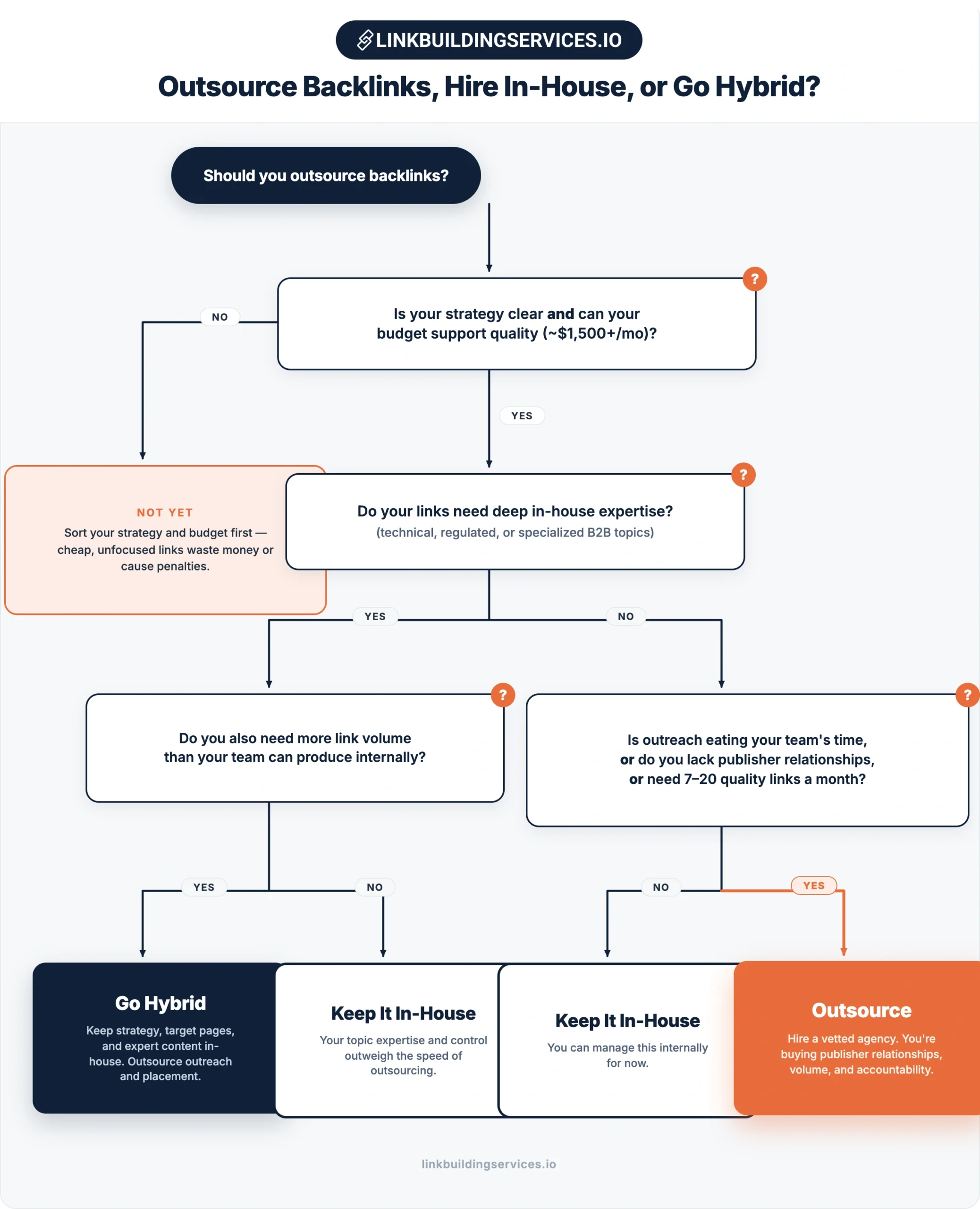
Before you compare the best link building services or budgets, you have to settle with the question: is outsourcing even the right move for your business right now? For some businesses it’s obvious. For others, handing this off too early will just buy fast movement in the wrong direction.
Outsourcing usually wins when:
- Outreach is eating your team’s resources with little to show for it. Link building is slow, relationship-heavy work. If someone internally is spending 8+ hours a week just pitching and landing a trickle of link placements, an established link building provider’s existing publisher relationships are worth paying for – given that network is the actual product you’re buying.
- You need consistent volume. Sustained link building programs of roughly 7 to 20 quality backlinks a month are difficult to manage without a dedicated hire and tools to match.
- You don’t have the publisher relationships. Cold outreach from an unknown brand converts poorly. A link building provider who’s already trusted by the right publications can skip the slowest part of the process.
- You’re closing a specific competitive gap and want experienced hands deciding which links you actually need, rather than just guessing.
Keeping it in-house makes more sense when:
- Your links depend on deep product or topic expertise – technical, regulated, or specialized B2B subjects where a generic outsourced writer will just produce content that undermines your credibility.
- Strategy is the real bottleneck, not execution – if you don’t yet know which pages need backlinks or which keywords really matter, fix that first. Outsourcing execution on top of an unclear strategy can just spend your money faster.
- Your budget can’t support quality yet – below roughly $1,000 to $1,500 a month, you’re usually forced to choose just between a few legitimate links and a large pile of risky ones.
The hybrid model is where most mature teams land. You keep the parts that actually need inside knowledge like strategy, target-page selection, and your best linkable assets like original research and tools – and you’ll just outsource the parts that can scale with relationships and volume – namely link building outreach and placement.
Your options compared: in-house, freelancer, agency, or marketplace
Once you’ve decided to outsource, you’re really choosing between four ways to buy. They may all end in backlinks, but they differ sharply on cost, how much control you keep, and how much risk lands on your brand.
Link building marketplaces almost always show the lowest price per link, and for a reason, given that you’re just buying inventory – not really judgment.
 So nobody really is deciding for you whether a website has real traffic, genuine editorial standards, or a clean backlink profile. If you have tools and experience to vet every link placement yourself, that can work. If you don’t, the savings are just borrowed against your domain’s health.
A freelancer can be an excellent or a disaster – and it entirely boils down to the individual. So you’re trusting one person’s standards, capacity, and continuity – which is fine for a test and risky for a link building campaign you’re depending on.
An in-house hire gives you the most control and cleanest ownership, but it’s the highest fixed cost and slowest to spin up. Here, you’re paying for salary, tools, and months it takes for someone to build the publisher relationships an agency already has.
A managed link building agency costs more per backlink than a link building marketplace, and that gap is the point here: part of what you’re paying for is a provider whose job is to not place a bad backlink in the first place.
The vetting, replacement guarantee, when links drop, and reporting you can actually read – that’s the actual difference between “we just bought some links” and “we truly invested in brand authority”.
The caveat here is that link building agencies vary widely in quality, which is exactly why the vetting standards and red flags matter.
Red flags: how to spot a link building provider who’ll burn you
The link building industry, to be honest, has a real quality problem and it’s structural: given that the barriers to entry are low, metrics are easy to fake, and the damage from a bad link building campaign can take months to surface.
And by the time you realize the links were junk, you’ve already paid – and possibly inherited a cleanup job. The good news here is that bad link building providers tend to give themselves away early.
Here are some signals that should end a sales conversation you have before you sign anything:
1. Guaranteed rankings
No one controls Google’s algorithm – that’s a reality, so one can’t really promise you position one or any specific position. Any ranking guarantee means the link building provider is either misrepresenting what they can deliver or just planning to force short-term movement with link building tactics that only invite a penalty.
Legitimate link building providers, as we know, only talk in terms of process and probability, not just promises.
2. Suspiciously cheap packages
Legitimate link building packages are priced around real editorial work — a backlink earned through outreach, relationship building, and content can’t be produced for $20 to $50. When the price is that low, the links are almost always coming from PBNs, link farms, or resold spam inventory.
You genuinely do need to get what you pay for here, and some cheap versions may often cost more than once you factor in recovery time and resources.
3. They won’t tell you where links will go.
Refusing to disclose target websites before you pay is the clearest warning sign there is. You need to ask directly whether they own the websites they place on: ownership of placement websites is a PBN tell.
A trustworthy link building provider lets you review and approve targets up front.
4. Impossibly fast turnaround
A genuine link building involves prospecting, outreach, content, and publisher review cycles that can take weeks. A link building agency promising 30+ links in a week is either just running automated outreach to low-quality sites or just pulling from a network it controls. So neither produces a link that can move rankings in a competitive niche.
5. DA/DR-only pitches
Domain Rating and Domain Authority are third-party scores that can be inflated by pointing artificial links at a website. So a DR75+ domain with 300+ real visitors is just worth less than a DR45 site with 40,000 genuine readers. Understanding how to get backlinks from high authority sites means judging real traffic and relevance, not scores — so if a provider sells purely on domain scores and never really mentions organic traffic or topical relevance, they’re just selling you a metric, not results.
6. Vague reporting.
“Great service, highly recommend” testimonials and just reports you can’t actually interpret are often just opaque by design. You should really be able to see publishers, anchor texts, traffic estimates, and live URLs – and truly understand what each link placement was meant to achieve.
7. No replacement policy for dropped links.
Backlinks disappear constantly -as websites go down, articles get deleted, publishers change policies. And given how common link rot is, a provider should treat link reclamation as part of the job; one with no replacement guarantee is just telling you they either place backlinks where removal is likely, or they just aren’t confident enough to stand behind their work. For example, a 12-month minimum link replacement policy is a baseline to expect.
8. Pressure tactics.
Time-limited discounts and urgency exist only to rush you past your own due diligence. So any link building provider worth hiring will just give you time to review their process, approve link placements, and check their references.
You should run any prospective partner through this list before you commit. Every red flag here has a mirror image – like a green flag and a provider who just volunteers transparent targets, itemized pricing, reporting, and a replacement guarantee is just showing you how they operate on the right side of all of them.
What does it cost to outsource backlinks?
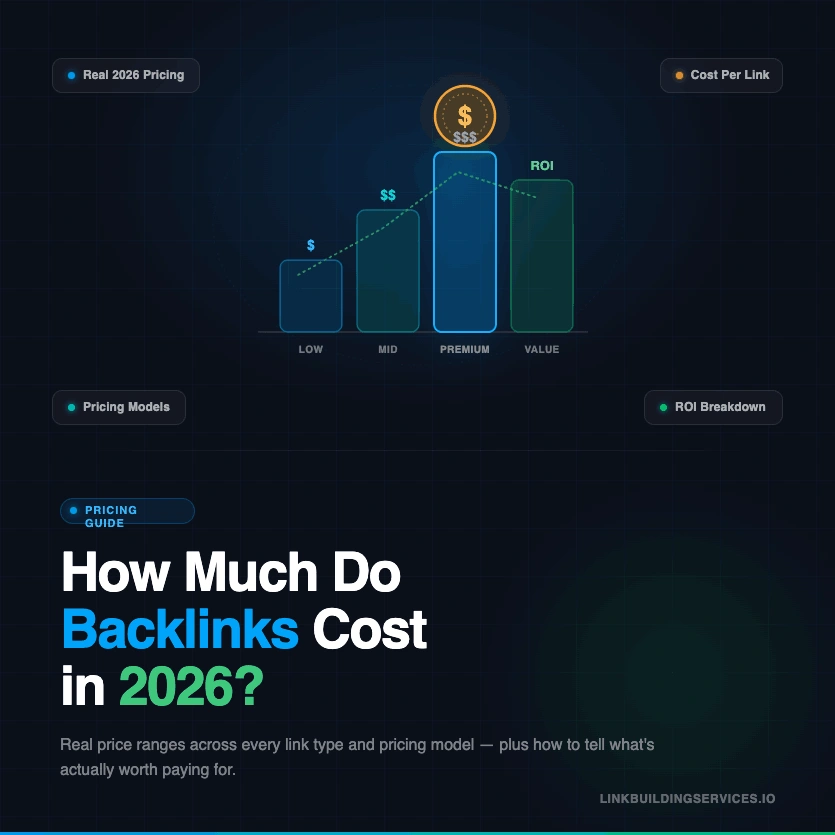
Short version: one quality backlink runs roughly $200 to $800, with industry studies landing between $361 (Ahrefs) and $509 (Editorial.Link) on average, and most managed monthly campaigns fall between $1,500 and $10,000+ depending on link volume, quality standards, and how competitive your niche is.
Knowing the best places to buy backlinks matters more than chasing the lowest rate, because the number that actually matters isn’t the per-link price – it’s actually the cost per result.
A $150 link on a site nobody reads is more expensive than a $500 link that earns real authority, given that the cheap one does nothing (or worse, needs cleaning up later). Where you sit in that range comes down to link type, the host site’s real traffic, and your industry.
We won’t rebuild the full breakdown here. We’ve already published actual rate cards, DR-tier pricing, and what makes one link worth 3x another in our guide to how much backlinks cost in 2026.
Written By

Reviewed By

Sef Gojo Cruz
COO at SharpRocket, overseeing end-to-end operations, from crafting link building strategies to leading high-performing teams. Previously led SEO initiatives at Workhouse, a digital agency in Australia, and Keymedia, a real estate media company based in New Zealand.