Ethical link building is the practice of earning backlinks from other websites through methods and strategies that are transparent with publishers, useful to readers, and within Google’s spam policies. It heavily relies on content, relationships, and topical relevance instead of aggressively manipulating rankings.
In this guide, we cover what Google’s spam policies actually say, how to weigh the common judgment calls, and 8 strategies that actually work. It also includes a five-question test that you can run on any link opportunity before you say yes.
In This Article
What is Ethical Link Building?
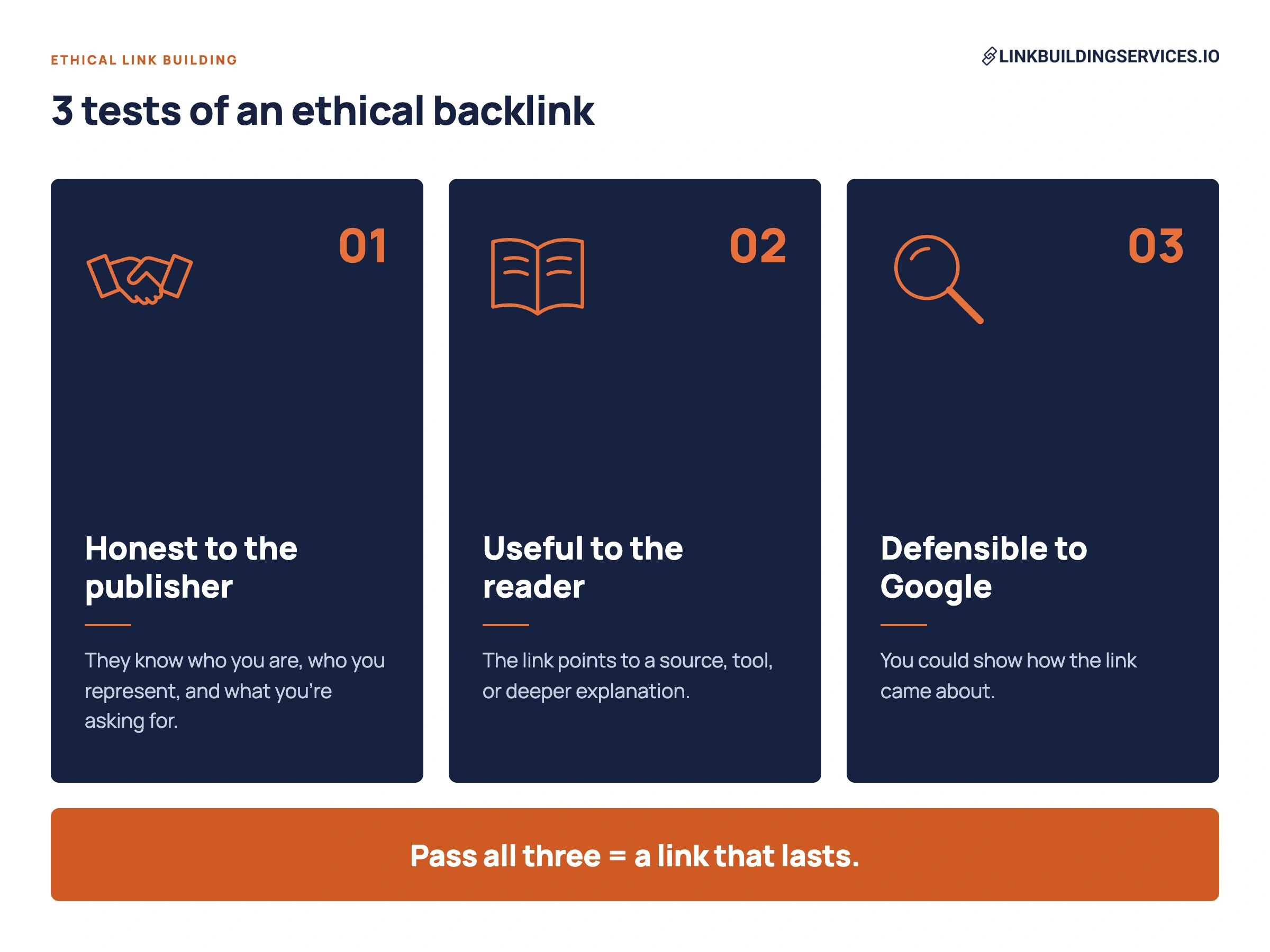
Ethical link building means getting other websites to link to yours in a way that you could explain openly to everyone involved. A backlink passes the bar when it meets three tests:
- Honest to the publisher – they know exactly who you are, who you represent, and what you’re asking for.
- Useful to the reader – the backlink must help the person reading that page, whether it points to a source, tool, or deeper explanation.
- Defensible to Google – you could show how the backlink came about without worrying about how it actually looks.
“Ethical” is also wider than just being “compliant”, as the link-building tactic can stay within the rules and still treat people badly. Like sending that same templated no-value pitch to like 5,000 site owners or publishers breaks no policy, but it truly just wastes their time and damages your brand’s name in their inbox (brand sabotage as we call it).
Practical payoff is durability, after all. Backlinks that pass all three tests above will tend to survive most algorithm updates and manual reviews, so the work you’re doing this year keeps paying off.
Why Ethical Link Building Matters
Backlinks are still one of the ways search engines decide which pages deserve to rank. How you earn them decides whether that value lasts.
Links That Last
A backlink that an editor chose to include tends to stay in place, and it keeps counting through algorithm updates. Links built on shortcuts are the first to be ignored or removed, which means paying twice for the same result.
Lower Risk
When your links can be explained openly, a manual review or a core update is nothing to worry about. You aren’t relying on something Google hasn’t noticed yet.
Traffic and Trust, Not Just Rankings
Links on relevant pages with real readers send visitors who are already interested in what you offer. They also put your brand next to names your audience trusts, which is the idea behind niche relevant backlinks.
Relationships That Compound
A publisher you treated well is far more likely to work with you again. Over time, those relationships make every new campaign easier than the last one.
What Google’s Spam Policies Actually Prohibit?
Google’s spam policies explicitly define link spam as links created mainly to manipulate search rankings. The policy targets intent and scale, not just link building itself.
Examples that Google lists include:
- Links exchanged for ranking purposes where your money, goods, services, or free products pretty much change hands and, in return, link passes ranking credit.
- Excessive link exchanges, including partner pages that are built only for cross-linking.
- Large-scale article or guest post campaigns with keyword-rich anchor text.
- Automated link creation using programs or services.
- Links required by contracts or terms of service when your publisher isn’t allowed to qualify them.
- Low-quality directory and bookmark links.
- Widget, footer, and template links that are pretty distributed across many sites.
- Forum comments with optimized links in the post or signature.
Buying and selling links is a normal part of the web’s economy.
Google also says plainly that buying and selling links is a normal part of the web’s economy when it’s done for advertising and sponsorship. What it really asks is that those links be qualified with rel=”sponsored” or rel=”nofollow”, which can tell Google not to count them toward rankings.
Link Building Tactics: Where Each One Stands?
Most link building tactics aren’t good or bad on their own. What really matters is how they’re carried out: who the link serves, whether the site is relevant, and whether everyone involved knows what’s happening.
Here’s a table to help you sort the common link building tactics into three groups.
| Tactic | Where it stands | What decides it |
|---|---|---|
| Digital PR and original research | Sound | Publishers link because the story or data is worth citing |
| Reclaiming unlinked brand mentions | Sound | The mention already exists; you’re asking for a link to be added |
| Broken link building | Sound | You’re helping the publisher fix a dead resource |
| Expert quotes for journalists | Sound | The link credits a real contribution |
| Guest posts on relevant sites | Sound | Written for that site’s readers, one site at a time, with natural anchors |
| Sponsored posts and placement fees | Depends on execution | Relevance of the site, quality of the content, and how the link is labeled |
| Link insertions in existing content | Depends on execution | Whether the link improves the page for its readers |
| Link exchanges | Depends on execution | Occasional swaps between relevant sites vs. systematic trading |
| Free product for a review | Depends on execution | Whether the review is honest and the arrangement is clear to readers |
| Private blog networks and link farms | Avoid | Sites exist only to pass links, with no real audience |
| Hacked or injected links | Avoid | Placed without the site owner’s consent |
| Comment and forum spam | Avoid | Adds nothing for the people reading |
| Automated link creation | Avoid | Scale without relevance or editorial choice |
Two things stand out here if you notice. Every link building tactic in the first group shares one trait: someone at the publishing site chose to link given that it helped their readers. And every tactic in the last group shares the opposite: no real audience, no consent, or no editorial choice at all.
The middle group is where your real judgment comes in, and it’s why the same tactic can be a smart move on one website and a wasted effort on another. If you’re weighing two of the most common formats, guest posting vs niche edits covers when each one fits. The test below gives you a quick way to make that call.
Link Ethics Test: 5 Questions for Any Link Opportunity
When a link opportunity lands in your inbox, run it through these five questions. Each one is a yes or a no.
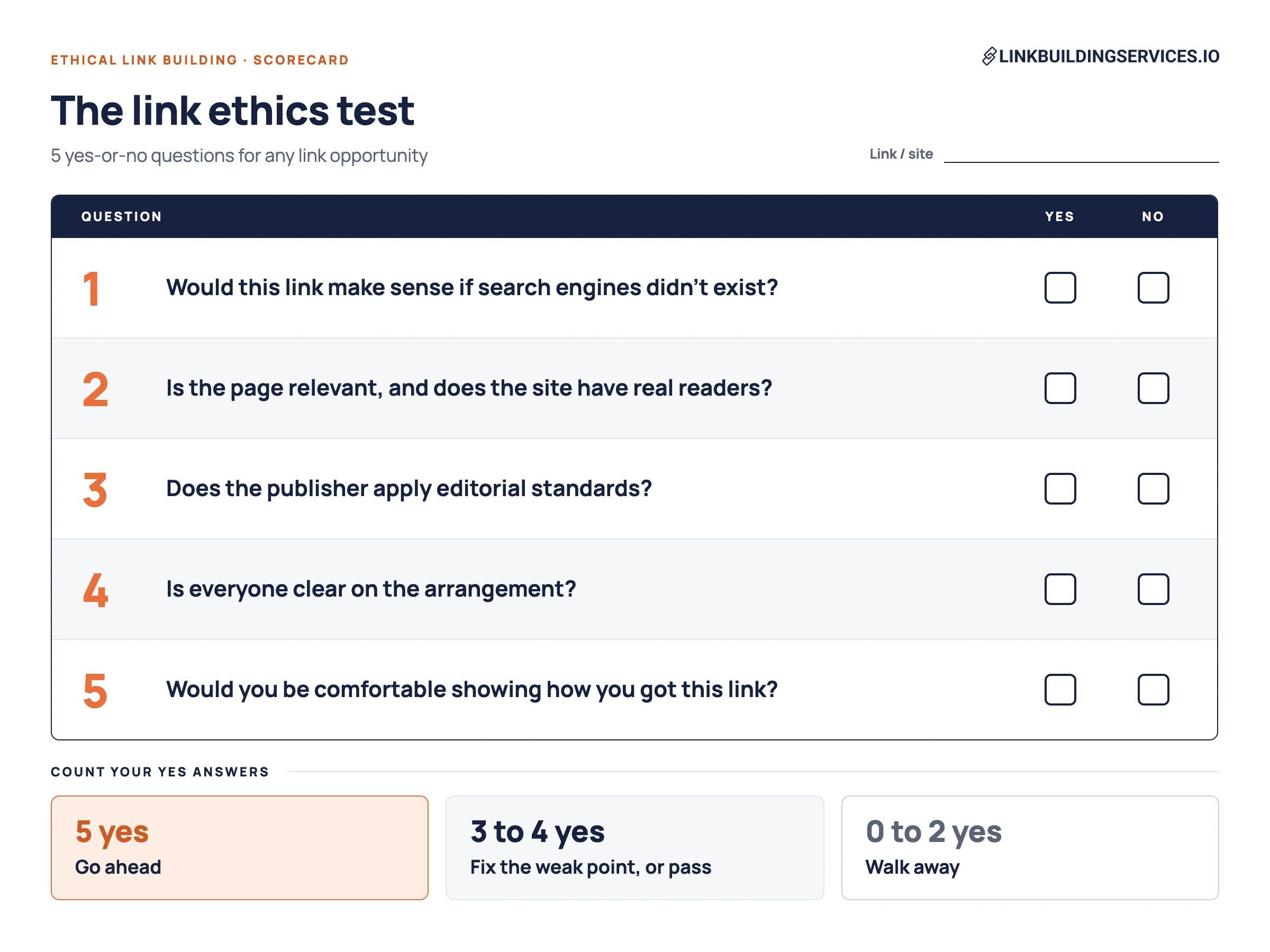
- Would this link make sense if search engines didn’t exist? A good backlink sends real people somewhere useful. If the only reason for it is rankings, that’s a no.
- Is the page relevant, and does the site have real readers? Look at the specific page, not just the domain. Check that it’s indexed, on your topic, and getting actual traffic. These are the same checks that separate powerful backlinks from weak ones.
- Does the publisher apply editorial standards? A website that reviews what it publishes, edits it, and turns things down is a website whose links mean something.
- Is everyone clear on the arrangement? The publisher knows who you represent and what you’re asking for, and nothing about it is hidden from their readers.
- Would you be comfortable showing how you got this link? Picture walking your client, your boss, or a Google reviewer through it step by step.
What the Score Means
| Yes answers | What to do |
|---|---|
| 5 | Go ahead |
| 3 – 4 | Fix the weak point, or pass |
| 0 – 2 | Walk away |
Three Examples
A marketing blog cites your original survey. A writer found your data, used a statistic, and linked to the source. It helps their readers, the page is on-topic, the editor chose it, nothing is hidden, and you’d show it to anyone. 5 of 5: go ahead.
A relevant industry site sends you its rate card for a contributed article. The site is on your topic and has steady traffic, so it passes questions 1 and 2. Whether it passes 3 and 4 depends on what you find: does the editor review and reject submissions, and is the placement presented clearly to readers? If so, it clears the test. If the site publishes anything from anyone, it drops to 3 or lower.
A vendor offers 50 links across “high-authority” sites in a week. You can’t see the sites in advance, the topics are unrelated to yours, and no editor is involved. 0 of 5: walk away.
The test won’t make the decision for you, but it shows you exactly which part of an opportunity is weak, and that’s usually enough.
8 Ethical Link Building Strategies
Each link building strategy below includes the steps, efforts involved, and what to really expect.
1. Publish Original Data or Research
Writers definitely need sources, and original numbers are the easiest thing to cite, after all. Like having a survey, an analysis of your own product data, or a study of public data all work.
- You can choose a question your industry keeps asking, but nobody has ever answered with numbers.
- Start gathering the data and pull out 3 to 5 clear findings.
- Publish it with charts and short methodology notes.
- Send it to writers and publishers who’ve covered the topic before.
Effort: High.
What to expect: Slow to produce, but one really good study can keep earning links for years. If a popular study on your topic already exists, publishing a clearly better version is the idea behind skyscraper seo link building.
2. Digital PR
Digital PR actually means pitching a story instead of just asking for links. The backlink comes because the journalist needs to credit the source.
- Find an angle that’s tied to something current: a trend, seasonal event, or a new regulation.
- Build the story around data, expert view, or a useful tool.
- Pitch a short list of journalists who can cover that beat.
- Make their job easy with quotes, visuals, and a clear summary.
Effort: High.
What to expect: Unpredictable from pitch to pitch, but the backlinks come from publications you can’t reach any other way. For campaign formats that tend to get picked up, see creative link building.
3. Reclaim Unlinked Brand Mentions
Some websites already mention your brand, product, or people without linking. So asking for the link is the simplest request in link acquisition, and it’s a core part of link reclamation.
- Start with setting up alerts for your brand name, product names, and key team members.
- Filter for mentions with no backlink.
- Email the author with a short thank-you and a URL that fits.
- Follow up once.
Effort: Low.
What to expect: The highest reply rates of any outreach campaign, given that the publisher already chose to mention you. Even the mentions that stay unlinked still carry weight, as covered in brand mentions for seo.
4. Fix Lost and Broken Links To Your Own Site
Links you’ve already earned can disappear when you change URLs or when one publisher updates a page.
- Pull a list of backlinks pointing to pages on your site that return errors (404s).
- Redirect those URLs to the closest live page.
- For backlinks a publisher removed during an update, you can ask whether your resource still fits.
- Recheck every quarter.
Effort: Low.
What to expect: Fast wins, given that redirects are fully in your control. See how to regain lost backlinks in ahrefs for the steps, and why use a backlink monitor tool if you’d rather catch lost links automatically.
5. Broken Link Building
When a page links to a resource that no longer exists, the publisher has a problem you can solve. Your competitors’ dead pages are a good place to start, which is one way to steal your competitors backlinks.
- Find dead pages in your niche that still have links pointing to them.
- Create or identify a page of yours that covers the same ground.
- Tell the exact publisher about the dead link and offer yours as a replacement.
- Only pitch when your page is a real match.
Effort: Medium.
What to expect: Modest reply rates, but the backlinks, as you know, sit in established, relevant content.
6. Contribute Expert Quotes to Journalists
Journalists will regularly ask for expert input, and those who contribute usually get credited with links.
- Sign up for any source-request platforms that are currently active.
- Respond only to requests where you have real expertise.
- Answer quickly, in 2 or 3 quotable sentences.
- Include your name, title, and one line of credentials.
Effort: Medium.
What to expect: Most responses would go unused, so your consistency matters more than volume. It’s also one of the more reliable answers to how to get backlinks from high authority sites.
7. Write Guest Posts For The Audience
Your guest post can earn its place when it’s written for that site’s readers and would be really worth publishing even without a link.
- Choose websites your own customers read.
- Study what they’ve published and truly pitch a topic they haven’t covered.
- Write to their standards and link to your site only where it helps the reader.
- You can use natural anchor text.
Effort: Medium.
What to expect: One strong post on a relevant website can beat 10 on sites that just accept anything. To build the prospect list, see how to lookup guest post opps on ahrefs.
8. Build Partner, Integration, and Community Links
Your existing business relationships are an overlooked source of links.
- List all your suppliers, software integrations, associations, and events you take part in.
- Check which of them have partner pages, directories, or case study sections on their websites.
- Offer a testimonial, case study, or a joint piece of content.
- Keep it to relationships that actually exist.
Effort: Low to medium.
What to expect: Limited number of links, but highly relevant ones that your competitors can’t easily copy. Offering a testimonial is one of the simplest routes in (see testimonial link building), and sponsoring or hosting events is covered in event link building.
Ethics of Outreach
How you ask for a backlink matters as much as where it actually ends up. Every email you send reaches a real person with a full inbox, and how you treat them can shape your brand’s reputation long after your link-building campaign ends.
Few rules can keep your outreach honest:
- Say who you are – use your real name and state who you represent – no invented personas or fake job titles.
- Skip the false flattery – don’t claim to be a long-time reader if you just found the website 10 minutes ago. Start mentioning something specific you actually read.
- Lead with their readers – explain why your resource can help their audience, not just why you need the backlink.
- Be clear about the ask – publisher should understand exactly what you’re proposing from the first email.
- Follow up once or twice, then stop – silence is an answer.
- Honor every “no” – remove anyone who opts out, and keep them off future lists.
Our guide to link building outreach goes deeper into templates and reply rates.
Example email template (broken link)
Subject: Dead link in your [page title]
Hi [Name],
I’m [your name] from [company], where I run [your role]. While reading your [page title], I noticed the link to [dead resource] in [section] goes to a page that no longer exists.
We published [your page], which covers [what it covers]: [URL]. It might work as a replacement if you’re updating the post.
Either way, I thought you’d want to know about the broken link.
[Your name]
[Title, company]
Why it works:
- Subject line states the reason for the email, with no bait.
- First line can give a real name and company.
- Second sentence can prove the sender read the page and offers something useful before asking.
- Pitch is one sentence, with a specific reason the resource fits.
- Close leaves a decision with the publisher and applies no pressure.
Done for you
Want links you can explain to anyone?
Tell us which pages you need to move. We’ll build links the way this guide describes:
- Relevant sites and pages – not DR alone
- In-content, editorial placements – on pages with real traffic
- You approve every domain – before a single email goes out
Bottom Line
Ethical link building comes down to links you could explain openly: honest to the publisher, useful to the reader, and defensible to Google. Most real decisions sit in the middle group of tactics, so run each opportunity through the five questions before you say yes, and treat every publisher the way you’d want your own inbox treated.
For the wider rules that keep a campaign safe, see link building best practices, and for what links do beyond a single ranking, see benefits of link building. If you’d rather not do it in-house, our shortlist of the best link building services is a starting point.
Written By

Reviewed By

Sef Gojo Cruz
COO at SharpRocket, overseeing end-to-end operations, from crafting link building strategies to leading high-performing teams. Previously led SEO initiatives at Workhouse, a digital agency in Australia, and Keymedia, a real estate media company based in New Zealand.