Two backlinks may come from websites with identical Domain Rating, yet one might move your rankings within weeks while the other does nothing at all.
The main difference really is the page the link sits on, how relevant that page is to yours, where the backlink is placed, and whether anyone ever clicks it. Links that get those things right are what we call powerful backlinks.
In this guide, we cover what actually makes a backlink powerful. We’ll give you a simple 0 to 10 scoring checklist you can use on any link opportunity, rank the most valuable link types, and show you how to earn each one without aggressive or risky shortcuts.
In This Article
- What Is a Powerful Backlink?
- 7 Factors That Decide How Powerful a Backlink Is
- DR vs. Relevance: Which Matters More?
- Link Power Score: 0 – 10 Checklist for Any Backlink
- Most Powerful Types of Backlinks, Ranked
- How to Get Each Type of Powerful Backlink
- Backlinks That Look Powerful but Aren’t
- Why Powerful Backlinks Lose Power Over Time
- Powerful Backlinks in AI Search
- How to Measure Whether a Backlink Worked
What is a Powerful Backlink?
A powerful backlink is a link that changes how search engines see the page it points to. It passes strong ranking value, signals that your page is topically relevant, and ideally sends real visitors who engage and read.
Most backlinks don’t do all three. Plenty of links pass no value at all – so the difference boils down to the page the link sits on, not just the website as a whole.
Page-Level vs. Domain-Level Authority
Domain-level authority describes the website as a whole, while page-level authority describes the specific page your link appears on, and that’s the one that passes real value.
For instance, a backlink from a well-known domain can still be weak. If it sits on an old, orphaned page with no traffic and no internal links pointing to it, it brings very little value to your website. But a mid-sized niche site linking to you from a page that ranks, gets organic visits, and is linked from elsewhere on the site can be far stronger.
So when you judge a backlink, look at the page first and the domain second – the same rule applies when you’re working out how to get backlinks from high authority sites.
Why “Power” Isn’t One Metric?
Domain Rating (Ahrefs), Domain Authority (Moz), and URL Rating are all third-party estimates, as each tool builds its own model of how strong a website or page’s backlink profile looks. They’re useful for comparing websites quickly and for screening out spam, but they’re approximations, not Google’s own scores.
Link power is a mix of backlink factors: topical relevance, the linking page’s quality and traffic, placement, anchor text, and how many other backlinks compete on the page. It’s also why link popularity is best judged by relevant referring domains, not raw link counts.
Google doesn’t use DR or DA.
These metrics are made by SEO tool companies. Google has its own internal signals, and they aren’t public. A high DR can suggest a link is strong, but it can’t prove it.
7 Factors That Decide How Powerful a Backlink Is
These are seven critical factors that will help you decide what a powerful backlink truly is. The first three usually matter most.
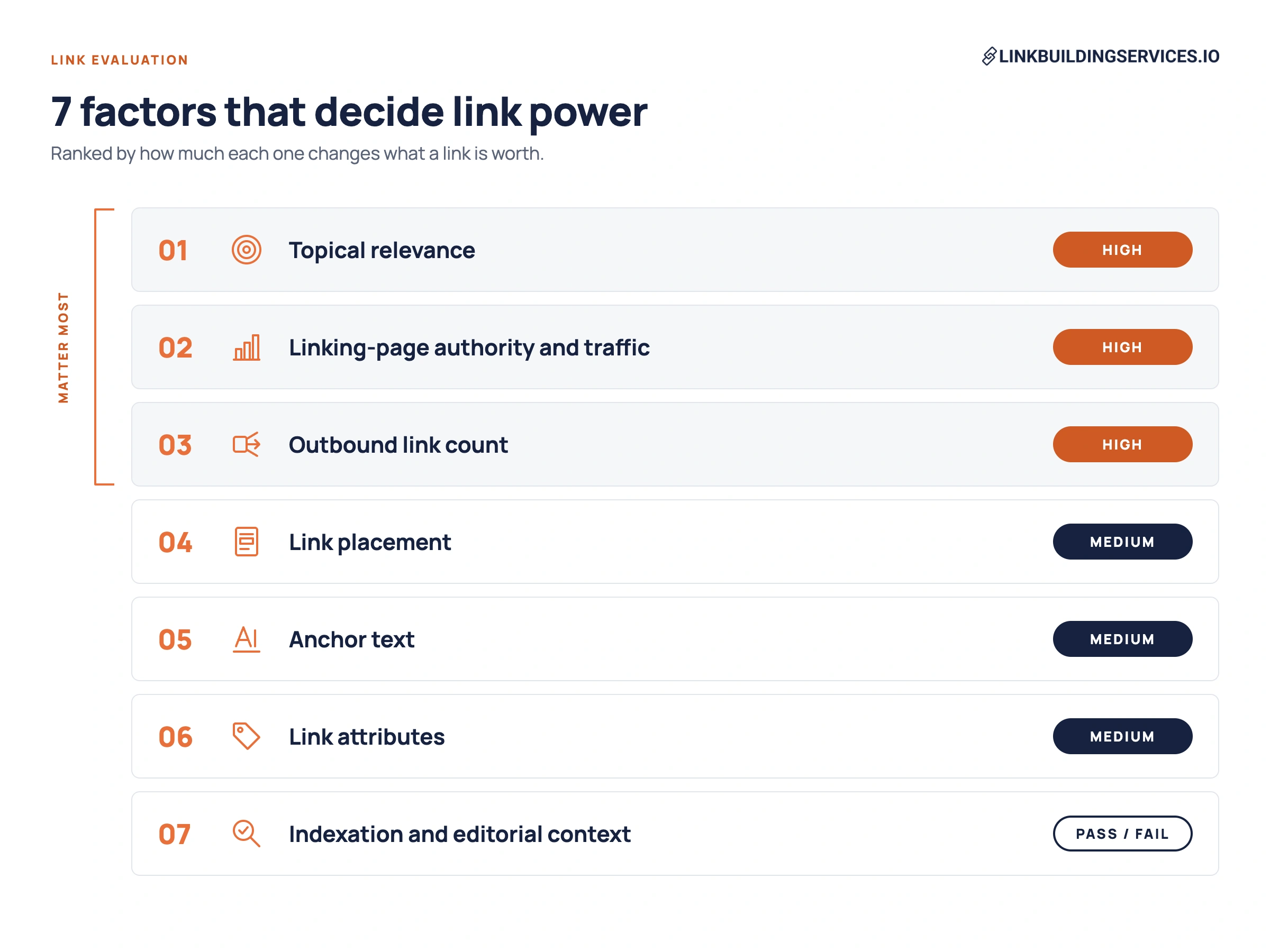 1. Topical Relevance
This is where a backlink from a site and page about your topic tells search engines your content belongs in that subject area. A link from an unrelated niche, even a large one, sends a much weaker signal – which is the whole case for niche relevant backlinks.
How to check it: Look at both the website and the specific page. For instance, a marketing blog linking to your SEO guide is highly relevant, while a marketing blog linking to it from a post about pet food isn’t, or at least much less so.
2. Linking-Page Authority and Traffic
The page your link sits on needs to have value of its own to pass any along. Pages that rank for keywords, get organic visits, and are well linked internally tend to pass the most value here.
How to check it: In Ahrefs, Semrush, or any of the best link building tools, look up the exact URL – check its organic traffic, the keywords it ranks for, and its URL Rating. A page with zero traffic is a warning sign, even on a big website.
3. Outbound Link Count
Every page shares its value among the links on it. A page that links to five websites generally passes more to each one than a page that links to 150.
How to check it: Count the external links on the page, or use a browser extension that highlights outbound links automatically. Resource pages with hundreds of links and “top 100 sites” lists usually pass little to each individual link.
4. Link Placement
Where the link appears matters – this is link placement. A backlink inside the main body of an article, surrounded by related text, is generally worth more than one in a footer, sidebar, or author bio. Backlinks placed earlier in the content may also carry more weight, given that readers are more likely to see and click them.
How to check it: Open the page, find your link, and ask whether a real reader would notice it and have a reason to click.
5. Anchor Text
Anchor text is the clickable text of the link, and it helps tell search engines what your page is about. Descriptive, natural anchors help, for sure. A backlink profile full of exact-match keyword anchors, though, can look manipulated and become a risk.
How to check it: Review your anchor text distribution in your backlink tool. A healthy profile mixes brand names, URLs, partial matches, and natural phrases like “this guide”.
6. Link Attributes (dofollow, nofollow, sponsored, UGC)
Standard (dofollow) links pass the most value. Google treats nofollow, sponsored, and ugc as hints rather than strict rules, so these links may still carry some weight. Nofollow links can also send traffic, build brand visibility, and keep your profile looking natural – which is where most social backlinks earn their place.
How to check it: Inspect the link’s HTML, or use your backlink tool’s filters to see each link’s attribute.
7. Indexation and Editorial Context
A backlink on a page Google hasn’t indexed passes nothing. Context matters too: a link given because the author thought your page was genuinely useful is the kind search engines are designed to reward. A backlink dropped into a page that exists only to sell links is the kind they try to ignore.
How to check it: Search site: plus the exact URL to confirm the page is indexed. Then read the page and ask whether the link would still make sense if no SEO benefit existed – if it would, that’s a backlink worth having.
DR vs. Relevance: Which Matters More?
This is the question most guides on this topic can’t agree on, so it’s worth settling directly.
Case for Authority Metrics
Supporters of DR and DA have a point. Sites with strong backlink profiles tend to have more ranking value to pass along, and these metrics are quick to check, which makes them useful for sorting a long prospect list and filtering out obvious spam. Just remember DR is an estimate that moves with the tool’s own data – it can even shift when a site loses a single strong link, as covered in ahrefs dr dropped due to losing one link.
Case for Relevance
Relevance supporters point out that DR measures a whole domain, not the page linking to you, and not whether that page has anything to do with your topic. A high-DR site in an unrelated niche can pass little topical value, and it may send no visitors who care about what you offer.
Side-by-Side Example
Here’s a hypothetical comparison for a page about local SEO services:
| Factor | Link A | Link B |
|---|---|---|
| Domain Rating | 70 | 45 |
| Site topic | General lifestyle magazine | Small-business marketing blog |
| Linking page | Old “resources” page, no organic traffic | Ranking guide on getting more local customers |
| Outbound links on page | 120 | 8 |
| Placement | Footer-style list | In the body of the article |
| Likely referral traffic | Near zero | Steady, relevant readers |
On DR alone, Link A wins. On almost every other factor, Link B is the stronger link, and it’s the one more likely to help the page rank and bring in potential customers.
Verdict
Relevance and the quality of the linking page come first. DR works best as a tiebreaker between similar opportunities and as a spam filter, not as the main measure of a link’s value.
Link Power Score: 0 – 10 Checklist for Any Backlink
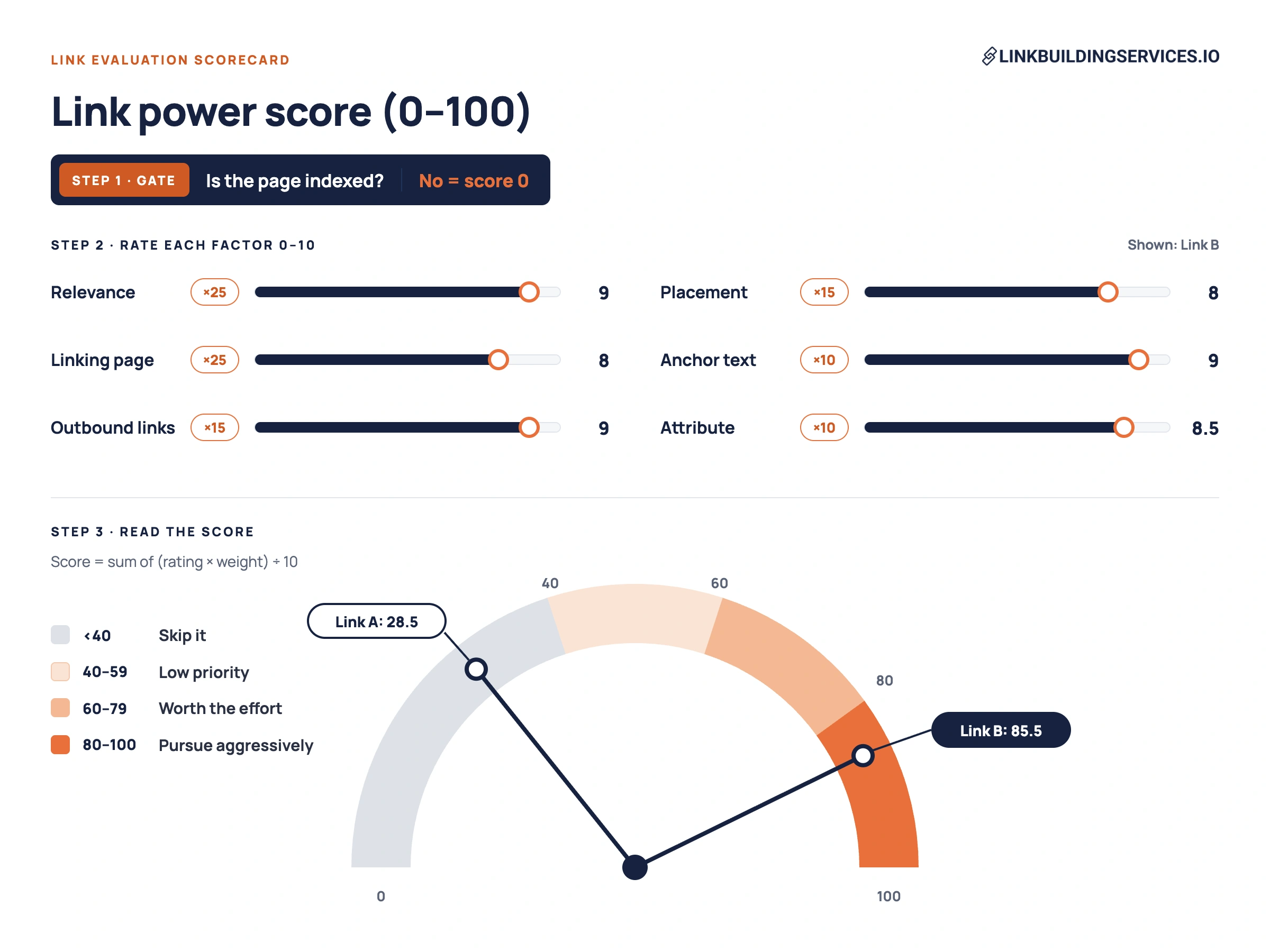
You can create your own link power score by scoring every link opportunity on the six factors below. Give each one a score from 0 to 10, multiply by its weight, add the results, and divide by 10. The result is a score out of 100.
One rule comes before scoring: if the linking page isn’t indexed, the link automatically scores 0. Nothing else counts until the page is in Google’s index.
| Factor | Weight | 0 points | 5 points | 10 points |
|---|---|---|---|---|
| Topical relevance | 25 | Unrelated niche | Adjacent topic | Same topic, same page intent |
| Linking-page authority and traffic | 25 | No traffic, no rankings | Some rankings, modest traffic | Ranks well, steady organic traffic |
| Outbound link count | 15 | 100+ external links | 20 – 50 external links | Under 10 external links |
| Placement | 15 | Footer, sidebar, or sitewide | Author bio or end-of-post list | In the body, in relevant context |
| Anchor text | 10 | Spammy or forced exact match | Generic (“click here”) | Natural and descriptive |
| Link attribute | 10 | – | nofollow, sponsored, or UGC | dofollow |
Formula: (Relevance × 25 + Page × 25 + Outbound × 15 + Placement × 15 + Anchor × 10 + Attribute × 10) ÷ 10
 What the Score Means
| Score | What to do |
|---|---|
| 80 – 100 | Pursue aggressively |
| 60 – 79 | Worth the effort |
| 40 – 59 | Low priority |
| Under 40 | Skip it |
Scoring the Two Example Links
Using Link A and Link B from the comparison above, and assuming both are dofollow:
| Factor | Link A (DR 70) | Link B (DR 45) |
|---|---|---|
| Relevance | 2 | 9 |
| Linking page | 1 | 7 |
| Outbound links | 2 | 9 |
| Placement | 2 | 10 |
| Anchor text | 5 | 7 |
| Attribute | 10 | 10 |
| Link Power Score | 28.5 (Skip it) | 85.5 (Pursue aggressively) |
A backlink with the higher DR lands at the bottom of the scale, while the lower-DR link lands at the top.
Most Powerful Types of Backlinks, Ranked
Essentially, not every link type carries the same potential. The table below ranks the most common ones by how strong they tend to be when done well, along with the effort they take and how much risk they carry.
| Link type | Typical score | Effort | Scalability | Risk |
|---|---|---|---|---|
| 1. Editorial links (digital PR, original data) | 75 – 100 | High | Medium | Low |
| 2. Niche-relevant guest posts | 60 – 85 | Medium | Medium | Medium |
| 3. Resource page links | 55 – 80 | Medium | Medium | Low |
| 4. Unlinked brand mentions | 55 – 85 | Low | Low | Low |
| 5. Broken link replacements | 50 – 80 | Medium | Medium | Low |
| 6. Expert quotes for journalists | 50 – 90 | Medium | Medium | Low |
| 7. Local and industry links | 45 – 75 | Low to medium | Low | Low |
| 8. Partner, supplier, and customer links | 45 – 75 | Low | Low | Low |
Score ranges are rough guides based on the rubric above. Real scores depend on the specific page.
1. Editorial Links From Digital PR and Original Data
These are powerful backlinks you earn because you published something others want to cite, such as a survey, industry study, free tool, or clear data visualization. Writers typically link to it because it supports their own content.
Best for: Brands willing to invest in content that gives journalists and bloggers a reason to reference it.
2. Niche-Relevant Guest Posts
You write an article for another website in your industry, with a link back to a relevant page on your site – that’s how guest posting works. Real link value depends almost entirely on the host publisher. Real blogs with real readers can help, while “Write for us” sites that publish anything for a fee usually don’t. If you’re weighing formats, guest posting vs niche edits covers when each one fits.
Best for: Building topical relevance and reaching a new audience in your niche.
3. Resource Page Links
Many websites keep curated pages that point readers to useful tools and guides on a topic. Getting listed on these well-maintained pages can send a very strong relevance signal.
Best for: Websites with a genuinely useful guide, tool, or template.
4. Unlinked Brand Mentions
Someone has already written about your brand or product but didn’t link to you – these are untapped unlinked brand mentions. Since they already know and mention you, a polite request to add the link often works and tends to convert well in email outreach. Turning those mentions into links is a core part of link reclamation.
Best for: Established brands that get talked about online, or ones with strong product positioning and word of mouth.
5. Broken Link Replacements
You find a dead link on a relevant page and suggest your content as a replacement. It solves a problem for the site owner, which makes the request easier to say yes to.
Best for: Niches with older content and plenty of outdated resources.
6. Expert Quotes for Journalists
Journalists and bloggers regularly look for expert sources through request platforms and social media. A useful, quick answer can help earn a link from a news site or a respected publication.
Best for: Founders, specialists, and anyone with real expertise to share.
7. Local and Industry Links
Examples include chambers of commerce, trade associations, local sponsorships, and event pages. They’re often easy to get and carry strong local and industry relevance. Sponsoring or hosting events is a tactic of its own – event link building covers it – and the best backlinks for local seo are the ones relevant in both topic and place.
Best for: Local businesses and companies active in their industry.
8. Partner, Supplier, and Customer Links
These all come from businesses you already work with, such as a “partners” page, a supplier directory, or a case study. This relationship makes them relevant by default. Offering a supplier a testimonial is one of the simplest routes in – see testimonial link building – and manufacturer and supplier pages are a staple of how to build backlinks for ecommerce.
Best for: B2B companies and any business with active partnerships.
How to Get Each Type of Powerful Backlink
Every tactic below works better when you have something worth linking to. Start there, then pick the tactics that fit your resources.
Start With a Linkable Asset
People link to content that helps their own readers. Before you do any outreach, make sure you have at least one page that earns attention on its merits:
- Publish original data – a survey, an analysis of public data, or results from your own work.
- Build a free tool, calculator, or template that solves a common problem.
- Write the most complete, up-to-date guide on a narrow topic.
- Turn complex information into a clear chart or visual others can embed.
If there’s already a popular page on your topic, making a clearly better version and pitching it to the sites linking to the original is the idea behind skyscraper seo link building.
Digital PR
- Find a story angle in your data a journalist would care about – a surprising trend, a local angle, a timely hook.
- Build a short list of writers who cover that exact topic.
- Send a brief pitch with the key finding in the first two lines.
- Follow up once, after about a week, then move on.
For campaign ideas that go beyond a standard press release, creative link building covers formats that tend to get picked up.
Guest Posts
- Vet each site with the Link Power Score before you pitch.
- Pitch two or three specific topic ideas that fit the site’s audience, not a request for a link.
- Write something as good as what you’d publish on your own site.
- Link to your site only where it genuinely helps the reader.
To build the prospect list itself, how to lookup guest post opps on ahrefs walks through the filters step by step.
Resource Pages and Broken Links
- Find resource pages with searches like intitle:resources “your topic” or inurl:links “your topic”.
- Find broken links with the Broken Backlinks report in Ahrefs, or a broken-link browser extension.
- Confirm your page is a genuine fit before reaching out.
- Tell the site owner exactly where the broken link is and what could replace it.
Often the closest matches are already linking to the pages above you, which is why many teams start by trying to steal your competitors backlinks before looking anywhere else.
Outreach Basics
Whatever the tactic, the same rules apply: personalize every email, lead with what’s in it for them, keep it short, and don’t follow up more than once or twice. Link building outreach goes deeper into templates and reply rates.
Sample outreach email (broken link)
Subject: Broken link on your [topic] page
Hi [Name],
I was reading your [page title] and noticed the link to [dead resource] no longer works.
We recently published [your page], which covers [what it covers]. It might be a useful replacement for your readers.
Either way, thanks for putting the list together.
[Your name]
Backlinks That Look Powerful but Aren’t
Some links look strong on paper and do nothing. Others can actively hurt you. Knowing the difference saves both money and rankings.
High DR, No Traffic
A high DR doesn’t guarantee a useful link. Be wary of sites with strong authority metrics but little or no organic traffic, pages that exist only to hold links, and packages sold as “guaranteed DR 70+ links”. Run any of these through the Link Power Score and they usually land well under 40.
PBNs and Bulk Cheap Links
Private blog networks (PBNs) are groups of sites built to link to other sites. They often share telltale patterns, such as the same templates, hosting, or thin content. Search engines are good at spotting these networks, and when they do, the links get ignored, the sites get deindexed, and the money is wasted. Cheap bulk packages tend to come from the same sources.
Easy backlinks like profiles and open directories sit in a different category – they’re fine for a natural-looking profile, but rarely powerful on their own.
Paid Links and Google’s Spam Policies
Google’s spam policies treat buying or selling links that pass ranking credit as a link scheme. There are two main risks:
- Devaluation – Google’s systems can simply ignore links they identify as unnatural, so you pay for nothing.
- Manual actions – in more serious cases, a reviewer can apply a penalty that lowers rankings until the problem is fixed and a reconsideration request is approved.
Paying for sponsored content is fine as long as the link is marked rel=”sponsored” or rel=”nofollow”. If you’re comparing paid options anyway, best places to buy backlinks covers how to vet sellers, and how much do backlinks cost shows what realistic pricing looks like – a price far below it is usually a red flag in itself.
Red-Flag Checklist
Walk away from a link opportunity if you see:
- Organic traffic that’s dropping sharply or already near zero
- Outbound links to unrelated topics, especially gambling, pharma, or crypto
- A “write for us” footer on every page, or a public price list for links
- Identical designs and templates across several sites in the same offer
- Posts that exist only to hold a link, with no real audience
- Anchor text chosen by the seller to match your keywords exactly
Whatever you build, keep it inside link building best practices – a powerful link that gets discounted isn’t powerful anymore.
Why Powerful Backlinks Lose Power Over Time
A link that scores 85 today won’t necessarily score 85 next year. Most guides stop at earning the link, but a link’s value depends on a page you don’t control.
Link Gets Removed or Changed
Pages get redesigned, articles get updated, and editors swap or delete links. Sometimes a dofollow link quietly becomes nofollow or sponsored. Nobody tells you – the link just stops counting.
Linking Page Loses Its Strength
If the page linking to you drops out of the rankings, stops getting traffic, or gets buried deeper in its site’s structure, it has less value to pass on. Your link is still there, but it’s worth less.
Monitor and Reclaim
Check your most valuable links on a regular schedule instead of waiting for rankings to slip. If you’re unsure it’s worth the setup, why use a backlink monitor tool makes the case. When a link does disappear, reach out quickly – editors are far more likely to restore a link they removed by accident – and how to regain lost backlinks in ahrefs walks through finding and recovering them.
Powerful Backlinks in AI Search
Being cited in AI Overviews and LLM answers works a little differently from ranking in the blue links. What matters more there is how clearly search engines understand your brand as an entity in your category – and links and mentions are a big part of that understanding.
Relevance counts even more in this setting. A link on a topically relevant, indexed page reinforces what your brand is about, and so does appearing alongside other trusted names in your space. That’s the thinking behind co citation link building, and it’s why unlinked mentions still carry weight – brand mentions for seo covers how they work.
So AI search doesn’t change what makes a backlink powerful. It raises the stakes on the factors that were already at the top of the list: relevance, real editorial context, and pages that search engines actually crawl and index.
How to Measure Whether a Backlink Worked
Checking what a link actually did is how you learn which links are worth chasing next time.
Set a Baseline First
Before the link goes live, record the target page’s current position for its main keyword, its total clicks and impressions, and the number of keywords it ranks for. Note the date the link was published.
Track Rankings and Clicks in Google Search Console
Watch the target page in the Performance report for 4 to 12 weeks after the link goes live, comparing average position, clicks, and impressions against your baseline. Links take time to be crawled and counted, so don’t judge the result after a few days – how long for backlinks to take effect sets out what normal movement looks like. And if a new link hasn’t appeared in your tool yet, backlinks not showing up in ahrefs explains the usual causes.
Check Referral Traffic in GA4
Look at the traffic acquisition report for visits from the linking domain. A link that sends engaged visitors has value, even if its ranking impact is harder to see.
Watch Total Ranking Keywords, Not Just One
A strong link often lifts a page across many related searches, not only its main keyword. Track the page’s total ranking keywords in Search Console or your SEO tool.
Keep Other Variables Steady
If you update the page’s content, change its title, or build several links at once, you won’t know which change made the difference. Where you can, leave the page alone during the tracking window.
Log every link against its score.
Record each new link’s Link Power Score next to the page’s results after 8 weeks. Over time, you’ll see which scores reliably predict ranking gains in your niche – and roughly how many backlinks do i need at that score to move a page.
Done for you
Want links that score high before you pay for them?
Tell us which pages you need to move. We’ll focus on the factors that actually make a backlink powerful:
- Relevant sites and pages – not DR alone
- In-content, editorial placements – on pages with real traffic
- You approve every domain – before a single email goes out
Bottom Line
A powerful backlink isn’t the one with the biggest DR. It’s a link from a relevant, indexed page with real traffic, placed in the content, with few competing links and natural anchor text. Score every opportunity before you spend time or money on it, and you’ll stop paying for links that look good in a spreadsheet and do nothing for your rankings.
Not every page needs links to rank – seo without backlinks covers where that works and where it stops. For the wider case of what links do beyond a single ranking, see benefits of link building, and our shortlist of the best link building services is a starting point if you’d rather not do it in-house.
Written By

Reviewed By

Sef Gojo Cruz
COO at SharpRocket, overseeing end-to-end operations, from crafting link building strategies to leading high-performing teams. Previously led SEO initiatives at Workhouse, a digital agency in Australia, and Keymedia, a real estate media company based in New Zealand.