Most link building for healthcare advice is pretty interchangeable. Just open five guides, and you’ll come across the same five directories. That’s actually a problem given that healthcare isn’t just a category anyone can afford to guess.
Google classifies medical content as YMYL – Your Money or Your Life – which actually means that the bar for who links to you, and why, is far greater than it is for just a typical business.
In this guide, we give you a trust-tier framework that sorts every link source into an earn, ignore, or avoid approach – and give you copy-and-paste outreach templates you can use today.
Why Healthcare Link Building Is Different?
If you’ve done link acquisition for eCommerce, SaaS, or local businesses, you already know the basic mechanics: find relevant websites, earn or place a link, watch authority flow to your pages. The playbook for how to build backlinks for ecommerce or SaaS backlinks rests on these same fundamentals — healthcare just raises the bar on who’s allowed to link.
Healthcare actually uses the same mechanics but really rewards them differently, and the reason boils down to how search engines treat the content.
1. YMYL raises the bar for every backlink
Google classifies medical and health content as YMYL (Your Money or Your Life) – as this category is reserved for pages that can affect someone’s health, finances, or safety. So any pages in this bucket are inherently held to a stricter standard, and that standard extends far to your backlink profile.
In a lower-stakes niche, a backlink from a high-authority but loosely related website might still pass useful link value. And in this industry, topical relevance and source credibility can carry far more weight than just raw domain metrics. So a backlink from a respected medical publication, a university health department, or a condition-specific nonprofit signals something a generic high-DR business blog simply can’t match, which is why knowing how to get backlinks from high authority sites matters more here than chasing volume.
2. E-E-A-T and Authorship Connection
Backlinks have to interact with broader trust signals Google looks for in health content – summarized as E-E-A-T: Experience, Expertise, Authoritativeness, and Trustworthiness.
Authorship matters – as the content credited to a licensed clinician, to give you an example, with verifiable credentials, is treated differently than an anonymous post.
So when backlinks point to that credentialed content, and when your authors are themselves cited or quoted across the web, signals reinforce each other – a form of co citation link building that’s especially powerful in health content.
A backlink to that page written by a board-certified physician, from a source that will also recognize that physician, from a source that also recognizes that physician’s expertise, is worth far more than a backlink to a thin, attributed article.
This is why the strongest healthcare link building strategies revolve around real experts – not just the caliber of the content.
3. Relevance and authority beat link volume
To put it simply, a smaller number of niche relevant backlinks will outperform a larger number of unrelated ones. And this may run against the instinct of many marketers who can bring from other niches, where link volume and DR can brute force results.
But in healthcare, ten links from health-adjacent, trustworthy sources will typically do more than a hundred scattered links from unrelated sites – and this scattered approach can raise flags, rather than rankings.
4. What works elsewhere but fails here
Mass directory submissions and low-quality niche edits will just add noise without topical relevance, and the usual guest posting vs niche edits trade-offs shift once you’re working in a YMYL niche. Generic guest posts on unrelated blogs (a staple of general SEO we have today) carry little weight when the topic has nothing to do with health.
Healthcare Link Source Trust Tiers
One of the better questions to ask for healthcare link building is “will this source actually help, do nothing, or hurt?. Given that every link opportunity you evaluate will fall into one of these three categories.
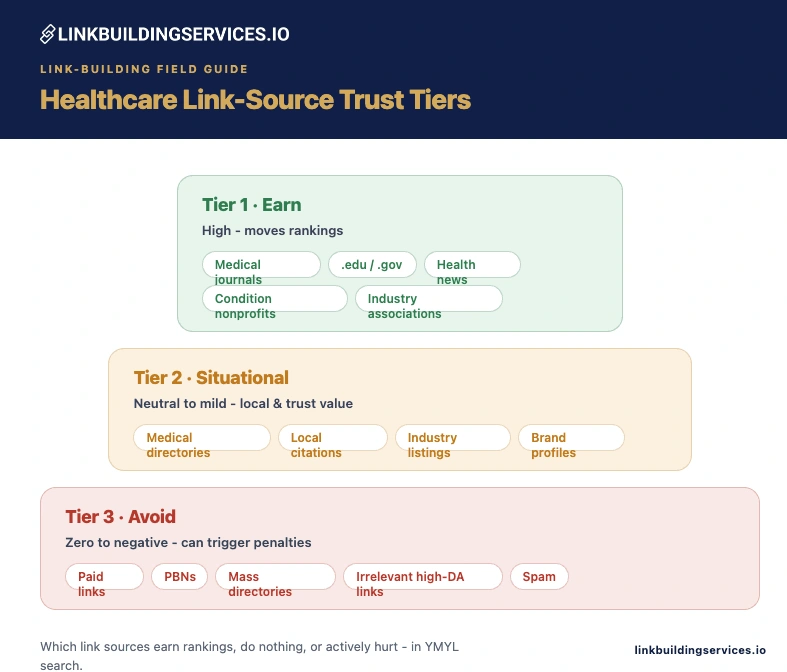
Tier 1 – Earn these (they move rankings)
These linked sources essentially combine topical relevance and genuine capability. So they’re the hardest to get and the most valuable – and should be the focus of your best efforts.
Medical and scientific publications, peer-reviewed journals, and health news outlets. University and academic health department pages (.edu ). Government and public health bodies (.gov, WHO, CDC-type sources) – among the toughest to earn, so it pays to understand how to get gov backlinks before you reach out.
Established condition-specific nonprofits and patient-advocacy organizations, so recognized industry associations and editorial mentions in mainstream publishers when the actual content piece is health-related – like a health article on a major news website.
Tier 2 – Situational (neutral to mildly useful)
These link sources won’t really hurt your site’s backlink profile – but you have to treat them as table stakes or just supporting signals.
Examples of these link sources are reputable medical directories and profile listings (Healthgrades, Zocdoc, Vitals, RateMDs, and similar). You may also tap on local business citations and chamber or community listings.
All these matter for local visibility, NAP consistency, and baseline legitimacy – if you run a local practice, it’s worth knowing the best backlinks for local SEO, but stacking more of them yields diminishing returns fast.
Tier 3: Avoid (dead weight or actively harmful)
All these range from useless to even penalty-risk – especially in a YMYL niche, the harmful end of this list is somewhat genuinely dangerous.
These may include aggressive link exchanges, private blog networks (PBNs), mass-submitted low-quality directories, and guest posts on unrelated, non-health sites that exist purely for links.
| Tier | Examples | Value | How to Get It |
|---|---|---|---|
| 1 · Earn | Journals, .edu/.gov, health news, condition nonprofits, associations | High — moves rankings | Original research, digital PR, expert commentary, resource outreach |
| 2 · Situational | Medical directories, local citations, industry listings, brand profiles | Neutral to mild; local/trust value | Claim, optimize, keep consistent |
| 3 · Avoid | Paid links, PBNs, mass directories, irrelevant high-DA, spam | Zero to negative | Don’t — reallocate the budget |
Baseline Citations and Medical Directories
Now, before you chase editorial stacks, you need to stack entities and foundation right. Directory and citation links, though on their own, won’t lift their rankings, but missing or inconsistent ones can quietly hold you back, especially for local practices.
Think of this like hygiene: necessary, finite, and something you can do once and maintain.
Two jobs directories actually do
Healthcadre directory links genuinely serve two different purposes – and it’s worth knowing which you’re getting:
- Authority/relevance value – it’s a listing on a well-known, health-specific platform that can add a small, legitimate topical signal.
- Local or NAP value – consistency behind Name, Address, and Phone data across directories will reinforce your practice’s local presence and support Google Business Profile rankings.
- Beyond the usual five
Here’s a baseline of directories you can start leveraging:
- General practitioner and practice directories: Healthgrades, Zocdoc, Vitals, RateMDs, WebMD Physician Directory, Doximity, and CareDash-type platforms.
- Insurance and network directories: your listings within the provider directories of the insurance plans you accept
- Specialty and association directories: most of the “find a provider” databases that are run by the professional body for your specialty – these are specialty-specific.
- Local and general business citations: Google Business Profile, Apple Maps/Business Connect, Bing Places, Yelp, and your local chamber or community listings.
The specialty-association and insurance directories are the ones most practices neglect, but they’re often more valuable than any generic directory.
Make the listings actually count.
To get the most value out of these directories, you can apply these tips:
- Claim every profile.
- Keep NAP identical across all of them (formatting, suite number, phone number).
- Complete the profile fully: hours, services, credentials, photos, and a real description.
- Link back to the correct page on your site (a location page if you operate multi-location).
Link Building Tactics For Healthcare That Actually Work
Below are tactics that include effort level, link quality, and when to actually reach for it:
| Tactic | Effort | Link Quality | When to Use |
|---|---|---|---|
| Original research & data studiesYour flagship link magnet — earn links once, collect citations for months. | High | Highest | When you have proprietary data or an audience you can survey and want compounding links. |
| Digital PR & expert commentaryClinicians answer journalist queries for attribution — fast, cheap, ongoing. | Medium · ongoing | High | Anytime a clinician can spend ~20 min/week responding to relevant queries. Low cost, high ceiling. |
| Resource-page outreachPitch a genuinely useful asset to “helpful resources” pages built to link out. | Medium | High · .edu/.org | Once you have a link-worthy asset to point to. Pointless without one. |
| Broken link buildingFind dead links on relevant pages; offer your working equivalent as the fix. | Medium | Matches host | A steady supplement to resource-page outreach, using the same prospecting lists. |
| Contributed articles (tier-1 publishers)Bylined expert content on respected health outlets — quality over volume. | High · per placement | High | When you have real expertise and editorial-quality writing, and want authority plus a byline. |
Original Research and Data Studies
One of the strongest link magnets in healthcare is creating and publishing something people have to cite like surveys of patients, analysis of anonymized treatment or any outcome data, benchmark reports, or trend studies in your specialty.
Journalists, bloggers, and other health websites may link to original data, given that they actually need a source.
Effort: High.
Link quality: Highest, often journals, news, and .edu.
When to use: When you have proprietary data or an audience you can survey, and really want compounding links.
Digital PR and Expert Commentary
Healthcare really has something most industries envy – and that is: credentialed experts. Reports are constantly looking for doctors and specialisties to quote.
So, using any expert commentary style-query services or journalist-request platforms can help you tap clinicians to provide expert commentary in exchange for attributions and links, and those brand mentions for SEO compound as your clinicians get cited across the web.
Effort: Medium, ongoing.
Link quality: High – mainstream and health media.
When to use: Anytime you have a clinician who’s willing to spend at least 20 minutes a week responding to relevant queries. It’s pretty low-cost, but high-ceiling in results.
Resource-page Outreach
Many health organizations, universities, and nonprofits are maintaining “helpful resources” or “patient resources” pages – so if you’ve built anything that’s a genuinely useful asset like a guide, tool, or explainer, you can pitch it for inclusion.
These pages often exist to link out, so asking for links is natural, the same link building outreach process applies as with any resource-page campaign..
Effort: Medium.
Link quality: High, often .edu/.org.
When to use: Once you have a link-worthy asset to point to.
Broken Link Building
Many health websites go stale, and links rot – if you can find broken links on relevant resource pages and offer your working equivalent as the link replacement. Here, you’re doing the site owner a favor, which can lift response rates above cold outreach.
Health sites go stale and links rot. Find broken links on relevant resource pages, then offer your working equivalent as the replacement. You’re doing the site owner a favor, which lifts response rates above cold outreach.
Effort: Medium.
Link quality: Matches the host page – often solid.
When to use: As a steady supplement to resource-page outreach, you can use the same prospecting lists.
Contributed articles to tier-1 health publishers
This tactic is more about placing genuinely, expertly crafted content on respected health publications – as the bar is pretty much higher, and volume is low – having a single article on a trusted medical outlet outweighs dozens of scattered posts.
Effort: High per placement.
Link quality: High.
When to use: When you have real expertise and editorial-quality writing to offer, and if you want authority plus a byline rather than just link volume.
Compliance and Regulatory-Safe Outreach
Link building in healthcare carries responsibilities most other industries never think about. So pushing outreach and content the way an eCommerce marketer would just, and you risk more than a wasted campaign – so you risk regulatory, legal, and patient-privacy problems.
Patient privacy comes first.
One of the fastest ways to turn a link building asset into a liability is when you expose patient information. Case studies, testimonials, and success stories are powerful link magnets, testimonial link building can be especially effective in healthcare, but any real patient detail may need explicit, documented consent, and often more than that.
In the U.S., HIPAA governs protected health information, and it doesn’t relax just because the goal is marketing. So when you use patient data in a study, story, or quote, it should be properly de-identified or used with clear authorization.
Truthfulness and advertising rules
Health claims draw scrutiny that ordinary marketing claims don’t. Any content that’s built to attract links like original research, expert commentary, or contributed articles (guest posts) has to be accurate, evidence-based and non-misleading.
FTC policies on deceptive health advertising, and unsupported claims about outcomes, cures, or efficacy can actually create liability beyond just SEO.
Segment-specific regulatory load
Local practices and clinics mainly need to protect patient privacy and keep claims honest. On one side, MedTech and health SaaS should add product-claim scrutiny – efficacy and outcome statements need substantiation.
While Pharma operates under the strictest regime, promotional content is heavily regulated, off-label discussion is often a serious hazard, and in many organizations, every outbound asset and message requires medical, legal, and regulatory review before publication.
Building compliance into the workflow
Make review part of your process – looping legal and compliance in early. It’s one of the link building best practices that matters far more in healthcare than in lower-stakes niches. Before assets are built, problems will get caught at the outline stage, rather than just after outreach has gone out.
Try to keep documentation of consents and claim substantiation. You should brief anyone doing outreach, especially clinicians giving expert commentary, on what they can and can’t say.
Written By

Reviewed By

Sef Gojo Cruz
COO at SharpRocket, overseeing end-to-end operations, from crafting link building strategies to leading high-performing teams. Previously led SEO initiatives at Workhouse, a digital agency in Australia, and Keymedia, a real estate media company based in New Zealand.