Brand mentions for SEO are online references to your content, business, and offers (products or services), counted with or without a link. They trust and credibility and can help drive more brand and topical authority – as they can help influence search engines’ ranking decisions to show your brand in AI Overviews.
AI systems and large language models (LLMs) use entity recognition to identify and assess brands across the web. Therefore, getting your brand to appear in trusted sources (even in linkless) can help improve your brand visibility.
Types of Brand Mentions
You can acquire different types of brand mentions, as long as they carry substantial value to your branding efforts. Here are the types of brand mentions that are worth considering.
1. Direct Mentions
These are explicit mentions of your company or product name, making it easy for search engines and AI systems to identify your brand as an entity (e.g., Rainmakers Training and Consultancy).
2. Contextual Mentions
These are brand mentions in industry-related discussions or content where the page’s context can associate your brand with relevant topics and content themes. For instance, our corporate training company got a contextual mention on a blog post about sales training in a section where it is referred to as an example.
3. Co-Citations
We’ve covered the basics of co-citations in our guide, where we define co-citations as brand mentions on a page alongside competitors, industry leaders, or other entities. One classic example is our brand, Rainmakers, getting featured alongside other Filipino training companies like Guthrie Jensen and Dale Carnegie.
4. Implied Links
As the name says, this type of brand mentions is an implied endorsement – where Google, as it says in its patents, suggests that this type of link can actually influence traditional rankings, much like how they see and assess traditional links.
5. Reviews, Forums, Q&A Sites, Podcasts
These are brand mentions that usually appear in user-generated content and third-party platforms, including but not limited to:
- Customer reviews (i.e. ,Trustpilot, Clutch)
- Forum discussions (i.e., Reddit, Quora)
- Q&A platforms recommending your brand, product/service, or content.
- Podcast interviews and other marketing channels showing your organization’s internal experts or thought leaders – getting referenced verbally or in show notes.
The beauty of this type of brand mention is that it’s authentic and carries more trust value, as it comes from real users and potential buyers of your brand—especially the ones with conversations that mention real entities in your space.
How to Earn Brand Mentions
You can manufacture (get it through outreach) or earn brand mentions. Either way, they don’t happen by accident, so you need consistency with your marketing and branding efforts to become more visible in your chosen niche.
Here are proven ways to earn brand mentions:
1. Content Marketing
As cliché as it sounds, producing helpful content is one of the best ways to earn brand mentions. Though the term “helpful content” is quite subjective, only users can dictate the helpfulness of your content.
That said, you must go off-site distribution—contributing valuable content on other websites to increase brand reach—as this could help you attract eyeballs and potentially brand mentions from different publishers.
Publish guest posts (yes, they still work effectively), PR features for new product launches or company-wide public announcements, and case studies to help position your brand as a credible source.
2. Data-Driven Insights
Data-driven content anchored on uniqueness, expertise, and original research can help drive brand mentions, as fresh data is a perspective most journalists and publishers would want to reference to validate or emphasize specific points in their content.
3. Digital PR & Newsjacking
Being one of the first to cover a story (breaking news) gives you the leverage of offering timely insights that journalists and content creators would pick up and reference – helping your brand quickly earn mentions in media coverage and relevant articles.
4. Partnerships and Collaborations
Done right, traditional partnerships and collaborations in your industry can bring exposure to new audiences and enable you to build thought leadership through podcast interviews where many hosts would typically include brand names of their guests in titles, descriptions, and promotional materials.
5. Community Engagement
Driven to provide value, active participation in relevant forum threads, Q&A platforms, and seemingly noisy social media platforms can open up opportunities for natural brand mentions.
When you provide helpful answers to users, your thoughtful content contribution attracts attention from other industry publishers, making it easier for them to reference your brand.
Measuring Brand Mentions
What gets measured gets improved. Tracking where your brand mentions have been placed can help you assess how visible your brand is online.
We use Ahrefs internally at SharpRocket to discover, track, and evaluate brand mentions effectively. It enables us to use various methods beyond setting up simple alerts to see the authority, relevance, and potential traffic value of each brand mentioned.
Finding Mentions with Ahrefs
You can use Ahrefs’ Content Explorer to search for your brand and find every page indexed that mentions it. Use filters (DR, traffic, language, date) to facilitate quality results and get the most valuable sources.
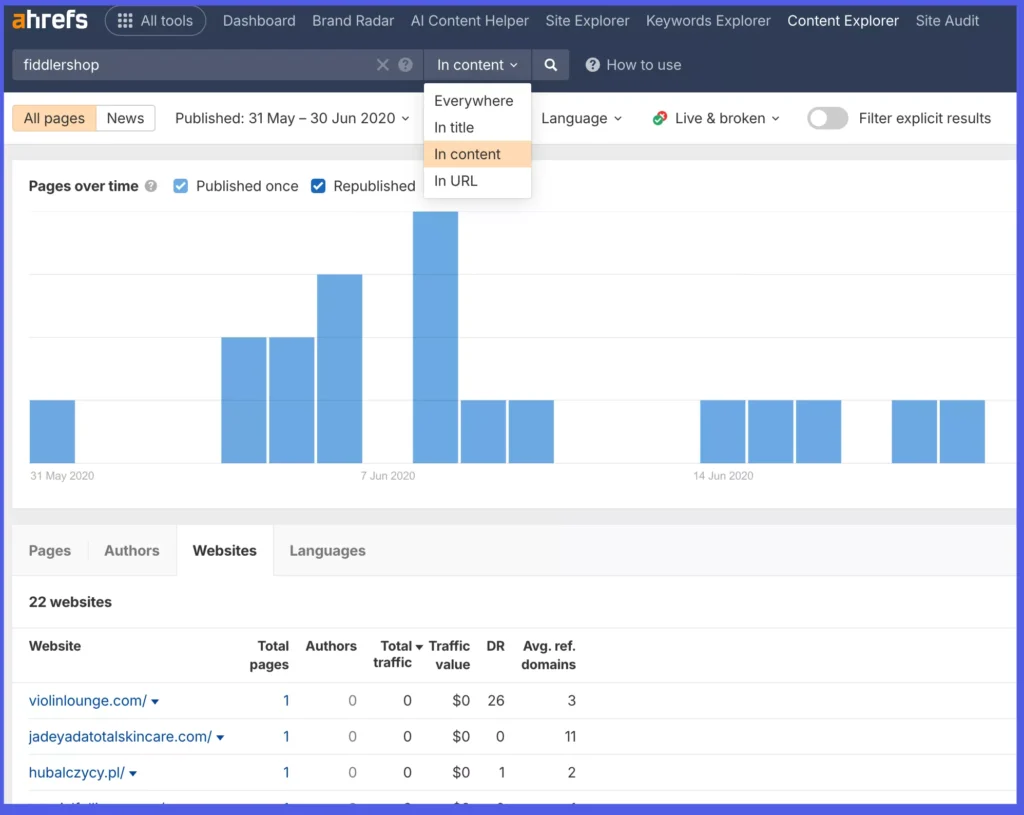
Set up an Ahrefs Alert for brand-related terms and get notified whenever new mentions appear on any indexed pages – linked or unlinked.
Quality and Quantity Metrics for Evaluating Brand Mentions
The first evaluation metric is the volume and frequency of brand mentions. Track how many times your brand is being mentioned and how often that happens.
Next, look at the source authority—what websites mention your brand? Are you getting linked or unlinked mentions from DR50+ sites, especially if your website is around DR30, let’s say? This carries more substantial value in terms of SEO than blogs/sites with less than DR10 blogs/sites.
Lastly, consider how much organic traffic each brand mention brings to your website—“traffic value”, as high-traffic pages with commercial intent are more valuable for getting links or mentions.
Qualitatively, we look at topical relevance (how brand mentions appearing in content are actually related to our industry), anchor text and surrounding text (as context), and co-citations (if mentions are listed among other entities or competitors).
Mapping Mentions to SEO Growth
Get third-party data from Ahrefs and match it against Google Search Console (Ahrefs also allows you to integrate your website’s GSC data, making this action step much easier).
Find correlations between rising brand mentions, keyword rankings, and organic traffic growth. Then, track whether consistent brand mentions on authority sites will align well with improved brand visibility on AI Overviews (AIO) and LLM’s AI-generated answers.
Written By

Reviewed By

Sef Gojo Cruz
COO at SharpRocket, overseeing end-to-end operations, from crafting link building strategies to leading high-performing teams. Previously led SEO initiatives at Workhouse, a digital agency in Australia, and Keymedia, a real estate media company based in New Zealand.